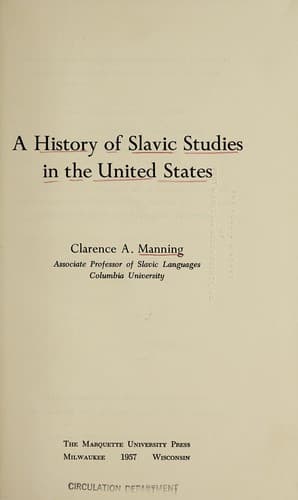
A history of Slavic studies in the United States — John Shaqi
A history of Slavic studies in the United StatesManning, Clarence Augustus
History
A history of Slavic studies in the United States
Manning, Clarence Augustus
Slavic philology -- Study and teaching; Slavs -- History -- Study and teaching
In 1924, this influx of immigrants was brought to a halt by the passing
of American immigration laws which introduced the principle of national
quotas and regulated the number of immigrants admitted each year by a
ratio based upon previous arrivals. This penalized the Slavs severely
for their immigration had been relatively recent and their quotas were
reduced almost to the vanishing point. Contrariwise, the peoples of
Northern Europe, who had arrived earlier, were assigned quotas which
they never filled.
So, from then until World War II, the American Slavic communities
remained relatively static in numbers, growing only by natural
increases. However, this was also a period when earlier efforts began to
bear fruit and Slavic cultural and financial importance increased
rapidly. The second generation, educated in American schools, was
beginning to produce a new type of leadership. It took its place in the
general American cultural, economic and political life with consequent
results upon both the country as a whole and upon the Slavs. There was
increased cooperation between the Slavs and the rest of the American
population, a period of growth and development from within.
After World War II, the displaced persons from Europe began to enter the
United States in large numbers. From 1939 on, there came a surprisingly
large number of highly educated persons, largely Poles, who were fleeing
from both the Nazis and the Communists. These new arrivals revivified
the intellectual and cultural interests of the older immigrants and
their descendants and, furthermore, they brought the best traditions of
education and scholarship from their homelands.
We can thus divide the growth of Slavic influence into four periods.
I. _From the beginning to 1848._ During this period, the immigrants
arrived as individuals and with few exceptions were absorbed rapidly and
almost completely into the main streams of American life.
II. _From 1848 to 1924._ This was the period of the mass immigration,
largely of unskilled laborers who came to secure the material benefits
of life in the United States. Yet it was also the period when the
general outlines of Slavic life in America were being sketched,
organizational and church affiliations were made, and the immigrant
groups were taking root as large units in the United States.
III. _From 1924 to 1939._ Despite the almost complete lack of
immigration, Slavic communities were beginning to attract the attention
of the American public. Internally they were completing their adaptation
to the American mode of life with far greater success than had seemed
possible a few decades before.
Public-domain text, read in full here on John Shaqi.
Reviews
Reviews
No reviews yet
Be the first to share your thoughts on this work.
Join the Discussion
Join the discussion
Sign in to leave a comment or review.
Sign InorCreate an account