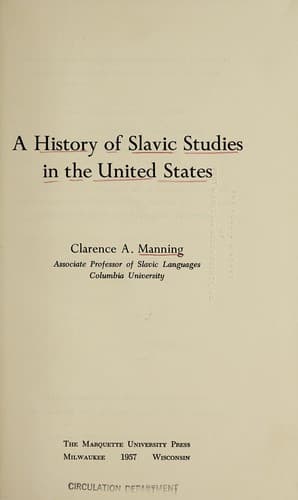
A history of Slavic studies in the United States — John Shaqi
A history of Slavic studies in the United StatesManning, Clarence Augustus
History
A history of Slavic studies in the United States
Manning, Clarence Augustus
Slavic philology -- Study and teaching; Slavs -- History -- Study and teaching
IV. _Since World War II._ Most of the leaders who refused to accept
Communism have come to the United States. The outstanding scholars and
artists have also come to find refuge. In some instances, it is no
exaggeration to say that centers of the higher culture have been
transferred to the United States. Simultaneously, the emergence of this
country as the spokesman and champion of the free world has awakened far
broader classes of the American public to the importance of the Slavs in
the modern world and has led to a greater demand for scholarship in
those fields which concern the Slavic nations.
There are thus two separate streams of Slavic scholarship in the United
States. The one is the normal inclusion of Slavic subjects, history,
culture and languages into the American universities and colleges. This
has been a normal process of development, just as in other areas of
study. Side by side with this, however, have been the efforts of the
national Slavic groups in the United States. These two streams developed
for many years in almost complete separation, but between the two World
Wars they began to affect each other. Since World War II, the two
streams are slowly but surely merging and it is probable that in the
future they will be completely consolidated to the advantage of Slavic
scholarship, the American people, and the entire free world which still
maintains those universal ideals that have come to dominate
civilization.
CHAPTER 3
SLAVIC STUDIES IN THE NINETEENTH CENTURY
Slavic studies were slow in making a formal appearance in American
colleges and universities. There were many reasons for this, not the
least being the general submergence of the Slavic countries (except
Russia) in the eighteenth century. At this period, the Slavic languages
were little studied in Germany or France, far less in England and thus
their absence in the United States is readily understandable.
In addition, the early American colleges, especially before the Civil
War, had limited curricula. They were modelled on Oxford and Cambridge
but, restricted in finances, libraries, and personnel, their curricula
were largely adapted to the presumed needs of the day. They were
intended to prepare men for the Protestant ministry or the law.
Enrollments were small and confined to certain groups of the population.
There was relatively little broad intellectual interest in the country
although men like Benjamin Franklin, Thomas Jefferson or even Count
Benjamin T. Rumford had won recognized places in the world of
scholarship and of ideas.
Public-domain text, read in full here on John Shaqi.
Reviews
Reviews
No reviews yet
Be the first to share your thoughts on this work.
Join the Discussion
Join the discussion
Sign in to leave a comment or review.
Sign InorCreate an account