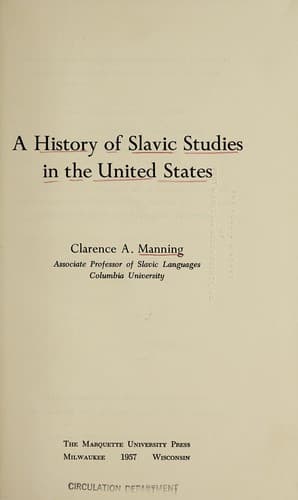
A history of Slavic studies in the United States — John Shaqi
A history of Slavic studies in the United StatesManning, Clarence Augustus
History
A history of Slavic studies in the United States
Manning, Clarence Augustus
Slavic philology -- Study and teaching; Slavs -- History -- Study and teaching
In the Orthodox and Catholic Uniat Churches, such instruction was
usually given by the dyak or cantor, a layman who superintended the
choirs and took a part in the services. These men had some education but
little training in teaching and their efforts were largely directed
along the same lines as in their homelands.
The Protestant and anti-clerical groups endeavored to find competent
laymen. These stressed the holding of classes in some lay building or on
the property of some secular organization.
As early as 1881, a journal in Johnson County, Iowa, the _Slovan
Americky_, started a campaign to raise money for a Czech college in
America. The newspaper believed that it could accomplish its purpose if
it succeeded in raising $20,000. The proposal, being launched by a
single newspaper, did not secure the support of rival papers and the
entire enterprise was dropped as a failure.[29]
Out of this chaotic and thoroughly unsatisfactory situation two
tendencies became evident just before World War I. Those Catholic
schools which had acquired some stability and organization began to take
the shape of the other parochial schools and where there was sufficient
demand and a sufficient concentration of worshippers, they began to
approximate the parochial high schools and then to pass over to be two
or three year colleges. The work of these was still not of high calibre
but the leaders were constantly striving to make them so. Thus, the
Czech Benedictines founded a school in Chicago in 1887. This passed
through the usual changes and after its removal to Lisle, Illinois, in
1901 it was reorganized as St. Procopius College, now a duly accredited
Catholic institution. St. Vincent College, Latrobe, Pennsylvania, with a
marked emphasis on Slovak, is another of these institutions.
We find the same activity among the Poles. St. Mary’s Seminary, Orchard
Lake, Michigan, early included Polish in its curriculum, as did St.
Francis Seminary, Milwaukee. Various religious orders have long
conducted courses in the Polish language on the high school level in
various centers of population. The Polish Roman Catholic Union, with its
library, was highly developed by Mieczyslaw Haiman, especially in
publishing studies of the career of such Polish soldiers in the United
States as Tadeusz Kosciuszko and the other Poles who fought in the
American Revolution. The Polish Historical Society also has done
outstanding work. All these represent the natural development of the
Poles and their descendants in America, and deserve more than passing
mention.
Public-domain text, read in full here on John Shaqi.
Reviews
Reviews
No reviews yet
Be the first to share your thoughts on this work.
Join the Discussion
Join the discussion
Sign in to leave a comment or review.
Sign InorCreate an account