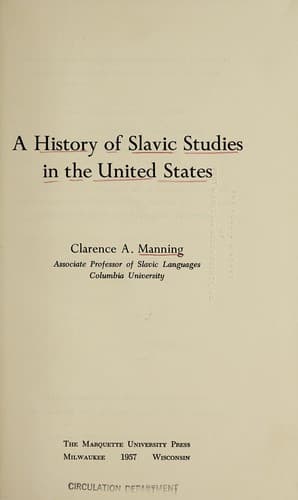
A history of Slavic studies in the United States — John Shaqi
A history of Slavic studies in the United StatesManning, Clarence Augustus
History
A history of Slavic studies in the United States
Manning, Clarence Augustus
Slavic philology -- Study and teaching; Slavs -- History -- Study and teaching
At the turn of the century, the fraternal organizations also began to
give the question of schools due consideration. Almost all appointed
committees on education and they too decided that the primary need was
the foundation of special colleges where instruction could be given in
the language of the homeland. Thus, in 1902 there was formed in Cedar
Rapids, Iowa, an institution, _Matice Vyssoho Vzdelani_, a center of
higher studies, by Bohumil Simek and G. F. Severa to work for the
establishment of a Czech college, but it also met with no success.
In 1903, the Polish National Alliance also created a committee on
education and schools, which worked for ten years and then in 1912, at
Cambridge Springs, Pennsylvania, opened the Polish National Alliance
College which was incorporated in 1914. Although it was rather on the
level of a high school, it profited by the opportunity to establish a
branch of the Student Army Training Corps during World War I. Its first
rector was Professor Romuald Piatkowski. In 1915, the work of the high
school or academy was augmented by the foundation of a Technical
Institute. It was in this status that the institution passed into the
next general period.[30]
Other forces were at work, however, to preserve the native languages by
introducing the Slavic languages into the already established American
institutions. While the motives were varied the efforts were made first
by the less clerical and the more Protestant parts of the population.
Thus, in 1887, the Congregational Church in Ohio persuaded the
authorities of Oberlin College at Oberlin, Ohio[31] to introduce a
course in Czech for candidates to the Congregational ministry who would
minister to the Czech communities. Professor Louis F. Miskovsky was
appointed instructor, and his became the first chair of Slavic studies
in an American institution. Oberlin’s program differed from the later
attempts at Harvard and elsewhere in that it was frankly intended only
to teach the language. Any Slavic cultural work in a broader sense was
insignificant. It is small wonder then that on Professor Miskovsky’s
death in the 1920’s, the chair was quickly abandoned and the money used
for a course of lectures on Central European affairs given by Professor
Oskar Jaszy, a liberal Hungarian who opposed both Communism and the
regime of Admiral Horthy.
In somewhat the same way, and for the same purpose, instruction in the
Polish language was introduced into Notre Dame University in 1909.
Efforts to include a Slavic language, usually Czech, in the curricula of
state and private colleges were particularly intense in Nebraska and
Iowa.[32] In these states, the Czech population had been among the
earliest settlers; many had prospered and secured appointive and
elective posts in the state governments, which gave them the opportunity
to work for the introduction of their native language into various
institutions.
Public-domain text, read in full here on John Shaqi.
Reviews
Reviews
No reviews yet
Be the first to share your thoughts on this work.
Join the Discussion
Join the discussion
Sign in to leave a comment or review.
Sign InorCreate an account