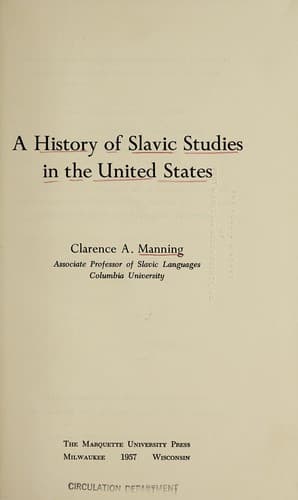
A history of Slavic studies in the United States — John Shaqi
A history of Slavic studies in the United StatesManning, Clarence Augustus
History
A history of Slavic studies in the United States
Manning, Clarence Augustus
Slavic philology -- Study and teaching; Slavs -- History -- Study and teaching
In 1903, Professor Bohumil Simek of the University of Iowa and F. J.
Pipal, a student of the University of Nebraska, established at Lincoln
the first of the Komensky Educational Clubs. These clubs were intended
to unite the Czech-Americans who had some education. The movement, which
included plans for building a monument to the Czech educator Jan Amos
Komensky (Comenius), spread extensively and finally included twenty-nine
societies, chiefly in the states of Nebraska and Iowa, although there
were some in Texas, Chicago and New York. For a while this loosely knit
organization was even able to publish a periodical bulletin.[33]
These clubs petitioned at once for the establishment of Czech language
courses at the University of Nebraska. Although the request was turned
down on the ground that there was a lack of interest in such a project
among the Czechs, a new attempt was made during the winter of 1906–07.
John Rosicky, an outstanding publisher of Czech newspapers in Nebraska,
and Vaclav Bures, both of Omaha, met the Regents of the state university
along with Frank Rejcha, a member of the Nebraska legislature. The
Chancellor of the university, in refusing the request, proposed a
political deal whereby a tax of one mill would be laid on certain
railroad properties and earmarked for the university. By clever
lobbying, the Czechs secured passage for the bill. Then the Governor of
the state cut the grants to the university and the Chancellor again
declined to set up a Slavonic department. Later the same summer,
however, another request was more successful and courses were started in
the fall of 1907.
The first instructor was Jeffrey Dolezal Hrbek, a graduate of Lafayette
College, Easton, Pennsylvania, and, at the time, a student in the
University of Iowa. He was appointed head of the new Department of
Slavonic and instructor in the Germanic languages and literatures.
Unfortunately Hrbek, a young man of great promise, became ill and died
on December 4, 1907.
He was succeeded by his sister Sarka B. Hrbkova, who graduated from the
University of Iowa in 1909 and received an M.A. from Nebraska in 1914.
Under her period of teaching, the department flourished. In 1910 she was
named adjunct professor; in 1914, an assistant professor; and in 1918,
she became a full professor. She was also very active during the war in
various aspects of Czech-American relations.
Public-domain text, read in full here on John Shaqi.
Reviews
Reviews
No reviews yet
Be the first to share your thoughts on this work.
Join the Discussion
Join the discussion
Sign in to leave a comment or review.
Sign InorCreate an account