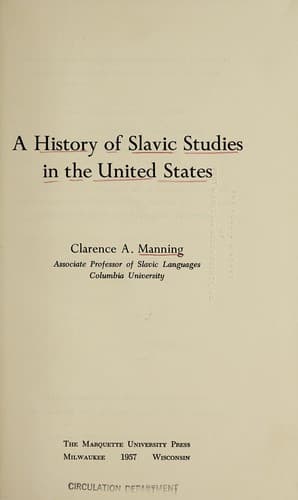
A history of Slavic studies in the United StatesManning, Clarence Augustus
History
A history of Slavic studies in the United States
Manning, Clarence Augustus
Slavic philology -- Study and teaching; Slavs -- History -- Study and teaching
We are on far surer ground when we come to the colonies established by
the English along the Atlantic coast. In 1610, the Virginia Company sent
to Jamestown, with Lord de la Warr, a group of Polish gentlemen as
workmen. These were apparently refugees in England from one of the many
upheavals in the _Rzeczpospolita_. Their names appear in Anglicized
forms and since we have no information about their experiences before
they reached England, many of them have been claimed by the Poles,
Ukrainians, and the other peoples included in the Polish state.[3]
The same situation prevailed in New Netherlands. There can be no doubt
that some of the settlers in the new Dutch colony were Slavs. Thus for a
long while, the name of the Zeboroski[4] family, one of the early
settlers, was written in Jersey Dutch. The family is proud of its Polish
origin but again like so many, it also has been claimed by the
Ukrainians. Another Slav of this period is Augustine Herrman, a skilled
surveyor from Prague. He apparently went first to Virginia, then moved
northward to New Amsterdam and later founded Bohemia Manor in Maryland.
Efforts have been made by both the Czechs and the Germans to prove that
he was of their origin but what proof there is favors the Czechs.[5]
Many other families, such as the Roosevelts, can trace their origin to
the Baltic states but leave us to decide from which particular group the
original ancestor came.
A still more tangled situation arose in the early colony of Delaware,
while it was still New Sweden. The Swedes eliminated the first Dutch
settlement around Fort Casimir and then in 1641 founded their own Fort
Christina and sent over a population of Swedes, Germans and Finns, and
all this at a time when the Poles and the Swedes were conducting their
own warfare behind the shelter of the Thirty Years War. At the same time
the Swedes were trying to make the Baltic a Swedish lake and their
representatives were deeply involved in negotiations with the
_Zaporozhian Kozaks_ who were in an almost constant state of revolt
against Poland. The Swedes then ruled both Livonia and Estonia. In view
of all this it would have been surprising indeed if there had not been
Slavs in the colony of New Sweden, the area in which the traditionally
American form of the log cabin seems to have originated, a form
reminiscent of the architecture of the East Baltic Slavs. The evidence
for New England is less clear, though we know that the authorities of
the new Harvard College seriously thought of inviting the distinguished
Czech educator, Jan Amos Comenius (Komensky) to serve as the first
president, in 1630. However, nothing came of it.[6]
Public-domain text, read in full here on John Shaqi.
Reviews
Reviews
No reviews yet
Be the first to share your thoughts on this work.
Join the Discussion
Join the discussion
Sign in to leave a comment or review.
Sign InorCreate an account