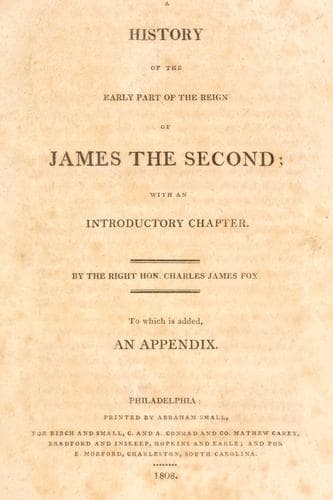
A History of the Early Part of the Reign of James the SecondFox, Charles James
History
A History of the Early Part of the Reign of James the Second
Fox, Charles James
Great Britain -- History -- James II, 1685-1688
Another period that affords ample scope for speculation of this kind is
that which is comprised between the years 1588 and 1640, a period of
almost uninterrupted tranquillity and peace. The general improvement in
all arts of civil life, and, above all, the astonishing progress of
literature, are the most striking among the general features of that
period, and are in themselves causes sufficient to produce effects of the
utmost importance. A country whose language was enriched by the works of
Hooker, Raleigh, and Bacon, could not but experience a sensible change in
its manners and in its style of thinking; and even to speak the same
language in which Spenser and Shakespeare had written seemed a sufficient
plea to rescue the commons of England from the appellation of brutes,
with which Henry VIII. had addressed them. Among the more particular
effects of this general improvement the most material and worthy to be
considered appear to me to have been the frequency of debate in the House
of Commons, and the additional value that came to be set on a seat in
that assembly.
From these circumstances a sagacious observer may be led to expect the
most important revolutions; and from the latter he may be enabled to
foresee that the House of Commons will be the principal instrument in
bringing them to pass. But in what manner will that house conduct
itself? Will it content itself with its regular share of legislative
power, and with the influence which it cannot fail to possess whenever it
exerts itself upon the other branches of the legislative, and on the
executive power; or will it boldly (perhaps rashly) pretend to a power
commensurate with the natural rights of the representative of the people?
If it should, will it not be obliged to support its claims by military
force? And how long will such a force be under its control? How long
before it follows the usual course of all armies, and ranges itself under
a single master? If such a master should arise, will he establish an
hereditary or an elective government? If the first, what will be gained
but a change of dynasty? If the second, will not the military force, as
it chose the first king or protector (the name is of no importance),
choose in effect all his successors? Or will he fail, and shall we have
a restoration, usually the most dangerous and worst of all revolutions?
To some of these questions the answers may, from the experience of past
ages, be easy, but to many of them far otherwise. And he will read
history with most profit who the most canvasses questions of this nature,
especially if he can divest his mind for the time of the recollection of
the event as it in fact succeeded.
Public-domain text, read in full here on John Shaqi.
Reviews
Reviews
No reviews yet
Be the first to share your thoughts on this work.
Join the Discussion
Join the discussion
Sign in to leave a comment or review.
Sign InorCreate an account