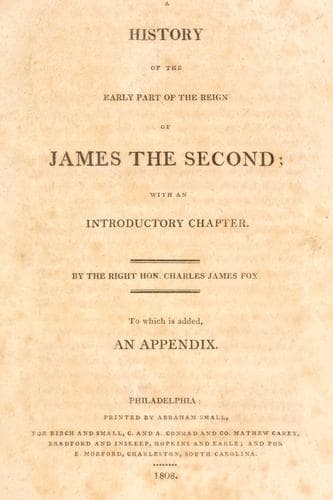
A History of the Early Part of the Reign of James the Second — John Shaqi
A History of the Early Part of the Reign of James the SecondFox, Charles James
History
A History of the Early Part of the Reign of James the Second
Fox, Charles James
Great Britain -- History -- James II, 1685-1688
The next period, as it is that which immediately precedes the
commencement of this history, requires a more detailed examination; nor
is there any more fertile of matter, whether for reflection or
speculation. Between the year 1640 and the death of Charles II. we have
the opportunity of contemplating the state in almost every variety of
circumstance. Religious dispute, political contest in all its forms and
degrees, from the honest exertions of party and the corrupt intrigues of
faction to violence and civil war; despotism, first, in the person of a
usurper, and afterwards in that of an hereditary king; the most memorable
and salutary improvements in the laws, the most abandoned administration
of them; in fine, whatever can happen to a nation, whether of glorious of
calamitous, makes a part of this astonishing and instructive picture.
The commencement of this period is marked by exertions of the people,
through their representatives in the House of Commons, not only
justifiable in their principle, but directed to the properest objects,
and in a manner the most judicious. Many of their leaders were greatly
versed in ancient as well as modern learning, and were even
enthusiastically attached to the great names of antiquity; but they never
conceived the wild project of assimilating the government of England to
that of Athens, of Sparta, or of Rome. They were content with applying
to the English constitution, and to the English laws, the spirit of
liberty which had animated and rendered illustrious the ancient
republics. Their first object was to obtain redress of past grievances,
with a proper regard to the individuals who had suffered; the next, to
prevent the recurrence of such grievances by the abolition of tyrannical
tribunals acting upon arbitrary maxims in criminal proceedings, and most
improperly denominated courts of justice. They then proceeded to
establish that fundamental principle of all free government, the
preserving of the purse to the people and their representatives. And
though there may be more difference of opinion upon their proposed
regulations in regard to the militia, yet surely, when a contest was to
be foreseen, they could not, consistently with prudence, leave the power
of the sword altogether in the hands of an adverse party.
Public-domain text, read in full here on John Shaqi.
Reviews
Reviews
No reviews yet
Be the first to share your thoughts on this work.
Join the Discussion
Join the discussion
Sign in to leave a comment or review.
Sign InorCreate an account