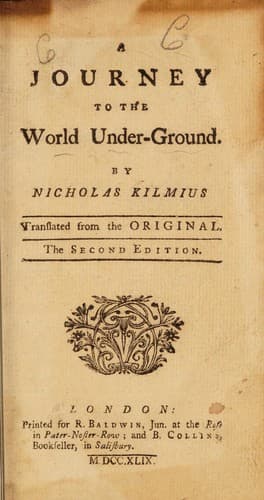
A journey to the world under-groundHolberg, Ludvig
Science
A journey to the world under-ground
Holberg, Ludvig
Utopias -- Early works to 1800; Voyages, Imaginary -- Early works to 1800
I observ’d one strange Custom in their Manner of administring Justice.
The Names of the contesting Parties are conceal’d from the Judges;
and the Differences are not decided in the Place where they arose,
but the Case is sent to the more remote Provinces to be determin’d.
The Reason of this strange Custom is this. Experience taught them,
that Judges were often corrupted by Presents, or sway’d by Partiality.
These Temptations they think they effectually remove, if the Parties
are conceal’d, if the Names of the Plaintiff and Defendant, together
with the Names of the Lands or Estates litigated, be all unknown. The
Reasons and Arguments alone are sent, at the Discretion of the Prince,
to whatever Court of Justice he thinks fit, with certain Marks and
Characters; for Example, “_Whether_ A _who is in Possession, ought to
restore the Thing possess’d at the Suit and Motion of_ B.” I should
rejoice to find such a Custom introduc’d among us, since we often
experience the fatal Force of Corruption and Partiality in the Minds of
our Judges.
Justice in general is freely administer’d without Respect of Persons.
Against the Prince only no Action can lie during his Life, but upon
his Death the publick Accusers, or (if one may so call them) the
Council for the Kingdom, cite him to Judgment. There in full Senate
the Actions of the departed Monarch are strictly examin’d, and at
length Sentence is pronounc’d, which according to the Merit of the
Deceas’d is distinguish’d by different Words and Characters, such as
these, _Laudably_; _Not illaudably_; _Well_; _Not ill_; _Tolerably_;
_Indifferently_; which Words are proclaim’d aloud to the People, and
afterwards engrav’d on the Monument of the Deceas’d. The _Potuans_
give this Account of that Custom: That the Prince while living cannot
be proceeded against without great Commotions and Disturbances; for
that during his Life a perfect Obedience and inviolable Veneration
should still be paid him, which indeed is the very Basis of Government.
But when that Obligation is dissolv’d by Death, the Subjects then
have Liberty to call his Actions to a strict Account. Thus by this
salutary, tho’ very paradoxical Law, the Security of the Sovereign
is provided for, his Authority not at all invaded, and the Welfare of
the People at the same Time promoted. For these Characters, tho’ given
to the Dead, are to the Living so many Spurs to Virtue. The _Potuan_
Histories for four hundred Years afford only two Instances of Princes
who bore the last mention’d Character, that is, that of _Indifferent_.
All the others obtain’d either the _Laudable_ or the _Not illaudable_
Character, as appears from the Inscriptions upon their sepulchral
Monuments, which have escap’d the Injuries of Time. The Character of
_Indifferent_, which in the _Potuan_ Language is call’d _Rip-fac-si_,
causes such Grief in the Royal Family, that the Successor of the
deceas’d Prince, with all his Kindred, mourn for six whole Months. And
Public-domain text, read in full here on John Shaqi.
Reviews
Reviews
No reviews yet
Be the first to share your thoughts on this work.
Join the Discussion
Join the discussion
Sign in to leave a comment or review.
Sign InorCreate an account