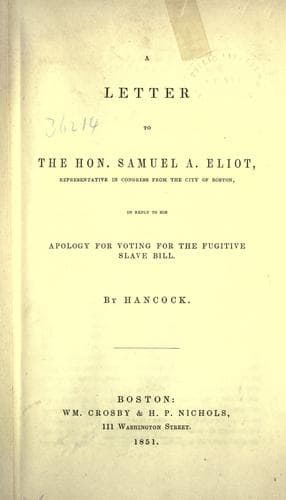
A Letter to the Hon. Samuel A. Eliot, Representative in Congress From the City of Boston, In Reply to His Apology For Voting For the Fugitive Slave Bill. — John Shaqi
A Letter to the Hon. Samuel A. Eliot, Representative in Congress From the City of Boston, In Reply to His Apology For Voting For the Fugitive Slave Bill.Dexter, Franklin
Philosophy
A Letter to the Hon. Samuel A. Eliot, Representative in Congress From the City of Boston, In Reply to His Apology For Voting For the Fugitive Slave Bill.
Dexter, Franklin
Eliot, Samuel Atkins, 1798-1862; Fugitive slave law of 1850; Slavery -- United States
It was not enough, it seems, that the wretched defendant in this
momentous issue should be subjected to the jurisdiction of a judge
unknown to the Constitution, holding his office by a prohibited tenure,
incapable of being impeached, and bribed to decide in favor of the
plaintiff by the promise of double fees, but the very trial allowed him
must be a burlesque on all the forms and principles of juridical
justice. The plaintiff, without notice to the defendant, prepares
himself for trial, and when his affidavits or witnesses are all ready,
he seizes the unsuspecting victim in the street, and puts him
_instanter_ on his defence. Had the wretched man been accused of some
atrocious crime, he might have demanded bail, and would have been
permitted to go at large to seek for counsel, to look for witnesses, and
to prepare for trial at some future day, of which he would have due
notice. But no such privilege is allowed a man who is accused of _owing
service_. One of your commissioners has already decided that the law
does not permit him to bail the prisoner. The slave power rides in
triumph over all the barriers erected by the wisdom of ages for the
protection of human rights. The defendant is brought, generally in
irons, before your commissioner judge, who is required "to hear and
determine the case of _the claimant_ in a summary manner." The law seems
not even to imagine the possibility of any defence being made on the
part of the defendant. It makes no provision for such a defence,--no
assignment of counsel, no summons for witnesses. We shall see presently,
that if the plaintiff makes out a _prima facie_ title, satisfactory to
the commission, it is all the law requires. Let me now call your
attention to the practical working of your diabolical law. A man named
Rose was lately seized at Detroit, and brought before a commissioner as
a fugitive slave. I copy from the newspaper report. "Mr. Joy (counsel
for defendant) moved a postponement of the trial to a future day, to
enable Rose to produce his papers to establish his right to freedom,
which papers he had _sworn_ were in Cincinnati. The counsel for the
claimant denied that the commissioner had any authority under the law to
grant a postponement. The commissioner agreed with the counsel for the
plaintiff, that _he had no authority to postpone the trial_; and he
further declared, that, _even were the papers by which Rose was
manumitted present, he could not under the law receive them in
evidence_."
Public-domain text, read in full here on John Shaqi.
Reviews
Reviews
No reviews yet
Be the first to share your thoughts on this work.
Join the Discussion
Join the discussion
Sign in to leave a comment or review.
Sign InorCreate an account