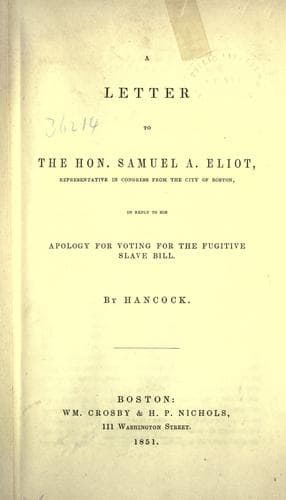
A Letter to the Hon. Samuel A. Eliot, Representative in Congress From the City of Boston, In Reply to His Apology For Voting For the Fugitive Slave Bill.Dexter, Franklin
Philosophy
A Letter to the Hon. Samuel A. Eliot, Representative in Congress From the City of Boston, In Reply to His Apology For Voting For the Fugitive Slave Bill.
Dexter, Franklin
Eliot, Samuel Atkins, 1798-1862; Fugitive slave law of 1850; Slavery -- United States
phraseology of the motion, and the objections of Messrs. Wilson and
Sherman, it was perfectly understood that the obligation of delivery was
imposed on the States, and that no power was intended to be conferred on
Congress to legislate on the subject. Messrs. Wilson and Sherman's
objections arose from no moral repugnance to slave-catching, but from
the inconvenience they apprehended the _State_ authorities would be
subjected to; and Mr. Wilson perhaps spoke from experience, as his own
State had at that very time a law for catching and returning fugitive
slaves from other States. The idea, therefore, that this agreement was a
_compromise_ between the North and South is wholly imaginary, and you,
Sir, must have mistaken some recent fulminations from the Southern
chivalry for the "deliberate declarations" which you suppose were made
in the Convention. Believe me, Sir, no members of the Convention ever
declared they would not enter into the Union, unless it was agreed to
surrender fugitive slaves, for the obvious reason, that the Northern
slaveholders required no threats from their Southern brethren to consent
to a compact convenient to both. It is very true, Sir, that there were
compromises, and that there were "deliberate declarations," but they had
no reference to the surrender of runaway slaves. I have pointed out your
historical mistake, not because it has the remotest bearing on your
justification, but because you seem to think that it has.
The first great compromise was between, not the North and the South, but
the small and the large States. The one claimed, and the other refused,
an equality of suffrage in the national legislature. It was at last
agreed, that the suffrage should be equal in one house, and according to
population in the other. This was the first compromise. Then came the
question, What should constitute the representative population? The
Southern States had more slaves than the Northern, and the former
insisted that slaves should be included in the representative
population. This would have given the Southern States an unfair
preponderance in Congress. Moreover, a portion of the Southern States
were engaged in the African slave-trade, and, of course, every slave
landed on their shores would increase their political power in Congress.
To reconcile the North to slave representation, it was offered that
_direct taxation_ should be proportioned to representation. But the
North was reluctant, and, as usual, was bullied into a compromise. Mr.
Davie, of North Carolina, made a "deliberate declaration":--"He was
sure that North Carolina would never confederate on any terms that did
not rate them (the slaves) at least as three fifths. If the Eastern
States meant, therefore, to exclude them (the slaves) altogether, the
business was at an end." (_Madison Papers_, p. 1081.) This threat, and
others like it, settled the matter. The compromise, of three fifths of
the slaves to be included in the representative population, was accepted
Public-domain text, read in full here on John Shaqi.
Reviews
Reviews
No reviews yet
Be the first to share your thoughts on this work.
Join the Discussion
Join the discussion
Sign in to leave a comment or review.
Sign InorCreate an account