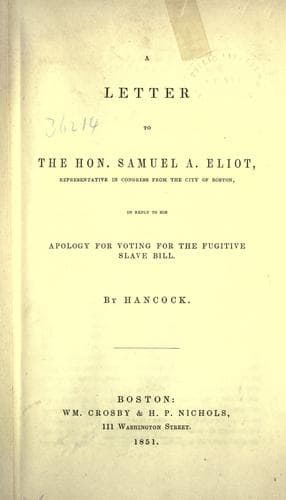
A Letter to the Hon. Samuel A. Eliot, Representative in Congress From the City of Boston, In Reply to His Apology For Voting For the Fugitive Slave Bill.Dexter, Franklin
Philosophy
A Letter to the Hon. Samuel A. Eliot, Representative in Congress From the City of Boston, In Reply to His Apology For Voting For the Fugitive Slave Bill.
Dexter, Franklin
Eliot, Samuel Atkins, 1798-1862; Fugitive slave law of 1850; Slavery -- United States
on the motion of _a New England member_; and the consequence is, that
the slave States have now twenty-one members in the lower house of
Congress more than they are entitled to by their free population. This
was the second compromise. There was still a third, far more wicked and
detestable, and effected by the "deliberate declarations" of Southern
members. The "committee of detail" has been already mentioned. It
consisted of Messrs. Rutledge of South Carolina, Randolph of Virginia,
Wilson of Pennsylvania, Ellsworth of Connecticut, and Gorham of
Massachusetts. This committee, it will be recollected, were to reduce to
the _form_ of a Constitution the resolutions agreed on by the
Convention. Neither in the resolutions themselves, nor in the
discussions which preceded their adoption, had any reference been made
to a guarantee for the continuance of the African slave-trade.
Nevertheless, this committee, of their own will and pleasure, inserted
in their draft the following clause:--"No tax or duty shall be laid by
the legislature on articles exported from any State, _nor on the
migration or importation of such persons as the several States shall
think proper to admit, nor shall such migration or importation be
prohibited_." To understand the cunning wickedness of this clause, it
must be recollected that Congress was to have power to regulate foreign
commerce, and commerce between the States; and hence it might, at a
future time, suppress both the foreign and domestic commerce in human
flesh, or it might burden this commerce with duties. Hence this artfully
expressed perpetual restriction on the power of Congress to interfere
with the traffic in human beings. As this grand scheme was concocted in
the committee, and not in the Convention, it may be interesting to
inquire into its paternity.
Public-domain text, read in full here on John Shaqi.
Reviews
Reviews
No reviews yet
Be the first to share your thoughts on this work.
Join the Discussion
Join the discussion
Sign in to leave a comment or review.
Sign InorCreate an account