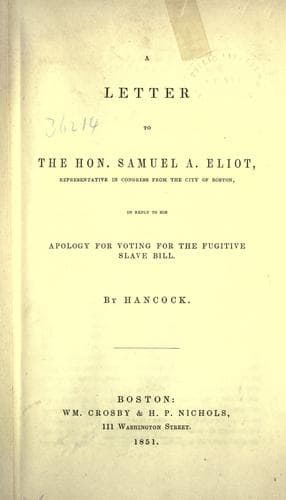
A Letter to the Hon. Samuel A. Eliot, Representative in Congress From the City of Boston, In Reply to His Apology For Voting For the Fugitive Slave Bill.Dexter, Franklin
Philosophy
A Letter to the Hon. Samuel A. Eliot, Representative in Congress From the City of Boston, In Reply to His Apology For Voting For the Fugitive Slave Bill.
Dexter, Franklin
Eliot, Samuel Atkins, 1798-1862; Fugitive slave law of 1850; Slavery -- United States
In the debates which ensued on this clause, Mr. Ellsworth, one of the
committee who reported it, "was for leaving the clause as it now stands.
_Let every State import what it pleases._ The morality or wisdom of
slavery are considerations belonging to the States themselves. _What
enriches a part enriches the whole_, and the States are the best judges
of their particular interests. The old Confederation had not _meddled_
with this point, and he did not see any greater necessity for bringing
it within the policy of the new one." "As slaves multiply so fast in
Virginia and Maryland that it is _cheaper_ to raise than to import them,
whilst in the _sickly_ rice-swamps foreign supplies are _necessary_, if
we go no farther than is urged [a proposal to permit the trade for a
limited time], we shall be unjust towards South Carolina and Georgia.
Let us not intermeddle." (_Madison Papers_, pp. 1389, 1391.) This
gentleman was one of your "very wise men"; and his mantle has recently
fallen upon other wise men from the East. Mr. Wilson, another member of
the committee, objected. "All articles imported," said he, "are to be
taxed; slaves alone are exempt. This is, in fact, a bounty on that
article." The clause was referred to another committee, who modified it,
by limiting the restriction to 1800. It was moved to guarantee the
slave-trade for twenty years, by postponing the restriction to 1808.
This motion was _seconded_ by Mr. Gorham, another member of the
committee. Mr. Randolph, also of the committee, was against the
slave-trade, and opposed to any restriction on the power of Congress to
suppress it. Two of the committee, then, we find, were against the
trade, and three, Messrs. Rutledge, Ellsworth, and Gorham, for
perpetuating it. And now, Sir, what were the inducements which prevailed
on the two wise men from the East to yield their consent to a
proposition so wicked and abominable? We are, of course, not informed
what passed in the committee, but we can well imagine, from the language
used by the chairman and others in the Convention. Said Mr. Rutledge,
"If the Convention thinks North Carolina, South Carolina, and Georgia
will ever agree to this plan [the Federal Constitution] unless their
right to import slaves be untouched, the expectation is VAIN. The people
of those States will never be such fools as to give up so important an
interest." In other words, "Gentlemen of the North, no Union without the
African slave-trade." Said Mr. Charles Pinckney, "South Carolina can
never receive the plan [of the Constitution] if it prohibits the
slave-trade. In every proposed extension of the powers of Congress, that
State has expressly and watchfully excepted that of meddling with the
importation of negroes." (_Madison Papers_, p. 1389.) Mr. Charles C.
Pinckney "thought himself bound to declare candidly, that he did not
think South Carolina would stop her importations of slaves in any short
time." Thus you see, Sir, that the "deliberate declarations" to which
Public-domain text, read in full here on John Shaqi.
Reviews
Reviews
No reviews yet
Be the first to share your thoughts on this work.
Join the Discussion
Join the discussion
Sign in to leave a comment or review.
Sign InorCreate an account