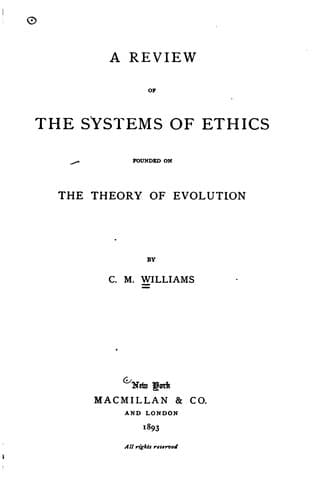
A Review of the Systems of Ethics Founded on the Theory of EvolutionWilliams, Cora May
Philosophy
A Review of the Systems of Ethics Founded on the Theory of Evolution
Williams, Cora May
Ethics, Evolutionary
No science is a better exponent of this radical and important change
than that which has to do with the principles of morals; for by no
science was the theory of evolution assailed, in the beginning, with
more vehemence and indefatigability. Not only did the zealous adherents
of Christian dogma fear to find, in the destruction of all distinct
barriers between the different forms of animal life, a ground for the
denial of God's especial favor to man, and the worshippers of emotional
morals become indignant at the unveiling of the divine Mystic (as if
only ignorance were reverence, and only the Unknown worthy of homage),
but even the less conservative schools of philosophy often showed
themselves unfavorable or hesitant towards the new ideas, dreading their
implications. All this is changed. If England's most popular living
philosopher was among the first to declare himself for Darwin, and to
revise his whole system in accordance with the theory of evolution, so
that this theory early began to find adherents among students of
philosophy in all lands where English is spoken, it was not long before
the newer schools of France and Germany began to follow in their wake.
Now every year, and almost every month, brings with it a fresh supply of
books, pamphlets, and magazine articles on "The Evolution of Morality,"
"L'Evolution de la Morale," "Die Evolution der Sittlichkeit,"
"Sittlichkeit und Darwinismus," etc. So many are the waters which now
pour themselves into this common stream that the current threatens soon
to become too deep and swift for any but the most expert swimmers.
In a short review of Evolutional Ethics, it will be impossible to
consider all the literature that has added to our knowledge on this
subject; we must confine ourselves to the few books that are most
prominent. The first laborer in this line, not only indirectly through
general theory, but also directly through particular theory, is, as
usual, Charles Darwin; and though Darwin was himself no psychologist,
and moreover advances his ideas on the origin and development of morals
only in the tentative manner that necessarily attaches to a first
attempt when made by so conscientious a thinker, he doubtless suggested
to all other writers in this field a very large part of that which was
best in their work. A Review of Evolutional Ethics must, therefore, in
order to start with the proper origin of the science, begin with
CHARLES DARWIN
In the essay on "Instinct" appended to G. J. Romanes' "Mental Evolution
in Animals,"[1] Darwin says: "The social instinct is indispensable to
some animals, useful to still more, and apparently only pleasant to some
few animals." The social tendency being thus classed as an instinct, it
belongs to our work to examine what are Darwin's theories as to the
origin and nature of instinct.
Public-domain text, read in full here on John Shaqi.
Reviews
Reviews
No reviews yet
Be the first to share your thoughts on this work.
Join the Discussion
Join the discussion
Sign in to leave a comment or review.
Sign InorCreate an account