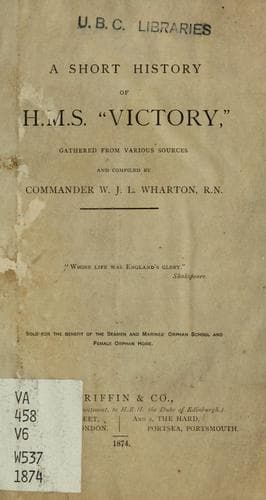
A Short History of H.M.S. VictoryWharton, W. J. L. (William James Lloyd)
History
A Short History of H.M.S. Victory
Wharton, W. J. L. (William James Lloyd)
Great Britain -- History, Naval; Victory (Ship)
The "VICTORY" was next destined to be the flagship of a squadron
fitting for service in the North Sea, under Vice-Admiral Hyde Parker,
who hoisted his flag in her on March 20th, 1781, at Portsmouth. On May
20th, she sailed for the Downs, with five other ships; but a few days
after her arrival at that anchorage, Admiral Parker shifted his flag
to the _Fortitude_, a 74, as being better adapted for cruising in the
narrow seas to which he was bound, and the "VICTORY," returning to
Spithead, hoisted the broad pendant of Commodore Elliott, and bore it
for one cruise with the fleet, in which nothing of importance took
place.
In September of the same year, Rear-Admiral Kempenfelt, hoisted his
flag as fourth Admiral of Channel fleet and cruised with it for two
months; but in December he was detached in command of a squadron of 12
sail of the line and 5 frigates, to attempt to intercept M. de
Guichen, who had sailed from Brest, with a convoy, carrying troops and
laden with warlike stores intended for the Count de Grasse in the West
Indies.
Early on the 12th December, when 40 leagues west of Ushant, the look
out frigate, _Tisiphone_, Captain James Saumarez, made the signal for
an enemy's fleet, and boldly crowded all sail to close them. In a
short time, when the day was fully broke, Kempenfelt found to his
disgust, that the enemy was much stronger than he had been led to
expect, as he could count 19 line of battle ships amongst the crowd of
ships to leeward of him; he therefore decided to watch his opportunity
before attacking; and, after sailing along with, and to windward of
the French fleet for a few hours, his patience was rewarded by
perceiving that the van and centre, with most of the men-of-war, were
separated by a slight gap from the rear. He at once made a dash for
the opening, and, while with the "VICTORY" and some others, he
engaged the rear of the French centre, and prevented their returning
to the rescue, his other vessels passed to leeward and captured the
whole of that division of the convoy--15 ships--sinking four frigates
that rashly, but most gallantly, endeavoured to protect them.
As the wind was now fair for England, he formed his fleet round the
prizes, and keeping up a running fire, carried the whole of the
captured ships into Plymouth in the face of the enemy, and despite
their utmost endeavours to prevent him.
Kempenfelt then returned to Spithead with his squadron, of which he
retained command till the month of March next year, when he struck his
flag in the "VICTORY," and hoisted it on board the _Royal George_.
In this ship he was unhappily drowned on the 29th August, on her
capsizing at Spithead, when over 900 persons perished in a few
minutes. The "VICTORY" was a witness of the melancholy catastrophe,
and her boats saved many of the survivors.
Public-domain text, read in full here on John Shaqi.
Reviews
Reviews
No reviews yet
Be the first to share your thoughts on this work.
Join the Discussion
Join the discussion
Sign in to leave a comment or review.
Sign InorCreate an account