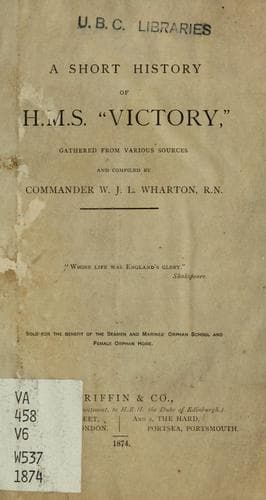
A Short History of H.M.S. VictoryWharton, W. J. L. (William James Lloyd)
History
A Short History of H.M.S. Victory
Wharton, W. J. L. (William James Lloyd)
Great Britain -- History, Naval; Victory (Ship)
Lord Howe next hoisted his flag in the "VICTORY" on assuming command
of the Channel Fleet, and cruised in the course of the summer of 1782,
but without any meetings with the enemy or incidents worth recording.
At this time, the attention of England, and indeed her enemies, was
almost entirely fixed on the defence of Gibraltar by General Elliot,
and the probable fate of that fortress, which though it had been
besieged by both sea and land for more than three years, had never
been so hardly pressed as now. Admiral Darby with a powerful fleet had
relieved the garrison from the greatest possible distress the year
before, but the supplies he then landed were now nearly exhausted, the
garrison were again commencing to feel the pangs of hunger, and it was
well known that the Spaniards had been for months making preparations
for an attack of a new kind, and on a grand scale, which they trusted
would compel the proud stronghold to lower its colours. The new
feature in the attack was the construction of ten large floating
batteries, so covered and protected as to be considered practically
invulnerable; these were armed with 154 pieces of the heaviest
ordnance, and backed up as they were by 48 French and Spanish sail of
the line, and 40,000 troops, the expected assault was enough to make
England tremble for the result. It was accordingly resolved to make a
great effort to relieve Gibraltar, and in such a manner that it
should be not only a temporary but a permanent relief and to this end
a fleet of 36 sail of the line was got together, which was to convoy a
large number of merchantmen, laden with every description of supplies,
and carrying troops to reinforce the garrison.
This fleet sailed on September 11th, with Lord Howe in the
"VICTORY," as Commander-in-Chief, and as Juniors, Vice-Admirals
Barrington and Millbank; and Rear-Admirals Alexander Hood and Hughes.
Before this succour could arrive, the grand attack on Gibraltar had
taken place. On September 9th the enemy's batteries, after a temporary
silence while preparing for the struggle, re-opened, and continued a
rain of shot and shell, with scarcely any intermission, to the 13th,
when the fleet and floating batteries being brought into their
assigned positions, joined in the bombardment.
It is not our province to relate the details of that memorable
day--enough to state that the arrangements which General Elliot's
energy had made were equal to the occasion; the invulnerable floating
batteries were set on fire, the fleet repulsed, the land attack took
no effect, and the baffled enemy, with enormous losses, withdrew from
active attack, to wait the results of the famine with which they well
knew the besieged were threatened, and which they hoped would effect
the capitulation their arms had failed to force.
Public-domain text, read in full here on John Shaqi.
Reviews
Reviews
No reviews yet
Be the first to share your thoughts on this work.
Join the Discussion
Join the discussion
Sign in to leave a comment or review.
Sign InorCreate an account