A study of some factors influencing fertility and sterility in the bull — John Shaqi
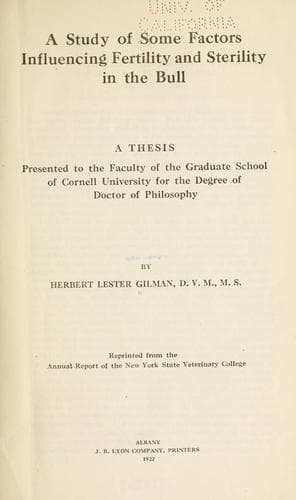
A study of some factors influencing fertility and sterility in the bullGilman, Herbert Lester
Science
A study of some factors influencing fertility and sterility in the bull
Gilman, Herbert Lester
Cattle; Infertility in animals; Livestock; Thesis (Ph. D.)
Henle (quoted by Ellenberger) states that a spermatozoon under favorable
conditions travels at the rate of twenty-seven millimeters in seven and
one-half minutes, which makes three and five-tenths millimeters per
minute. This is about sixty times the entire length of the spermatozoon,
and twenty-one centimeters in an hour. Forward motion is also more
pronounced when the swim is against the current, such as is produced by
the cilia of the oviduct. It has been demonstrated that feebly motile
sperms become very actively motile when placed on the mucosa of a fresh
Fallopian tube.
TECHNIQUE
The material used in the work came from abattoir animals, bull calves
and adult bulls raised in the department herd, and sires upon which
clinical observations had been made by various veterinarians in the
field. Semen samples, many of which were sent in, were collected as
often as possible after the method described by Williams (16). The
genital organs were removed with as little chance of contamination as
possible, and taken or sent to the laboratory where the examinations
were made soon after arrival.
All cultures were made by searing the surface carefully, tearing out a
small portion of the tissue with sterile forceps, and placing it upon
the media. In most cases, however, where fluids were present, tubes were
inoculated with the material which had been drawn off with a sterile
pipette. As stated by Carpenter (9), in his work on the female genital
tract, the organisms usually live in the depths of the tissue. The media
used principally were glucose glycerin agar (glucose 1 per cent,
glycerin 3 per cent); plain agar, both with a pH value of 7.4, and
Loeffler’s blood serum. Small amounts of sterile blood serum or
defibrinated blood were added to most of the agar slants to insure
better growths of streptococci when present. All tubes, to which the
serum had been added, were incubated for forty-eight hours before
inoculation to insure absolute sterility.
After inoculation, the agar tubes were sealed with sealing wax to give a
partial oxygen tension which was quite necessary in isolating the
streptococci. The growth of other organisms was by no means hindered by
the procedure, for one tube from each organ was often left unsealed.
Incubation was at 37° C, and the routine method of examining the tubes
was identical with the method of Carpenter (9).
Whenever possible, a sample of blood was obtained from the animal either
before, or at the time of slaughter, for agglutination with _Bact.
abortum_ antigen. Extracts from the seminal vesicles, testes, and
epididymes were injected into the guinea pigs and examined at the end of
four to six weeks for the presence of _Bact. abortum_.
Public-domain text, read in full here on John Shaqi.
Reviews
Reviews
No reviews yet
Be the first to share your thoughts on this work.
Join the Discussion
Join the discussion
Sign in to leave a comment or review.
Sign InorCreate an account