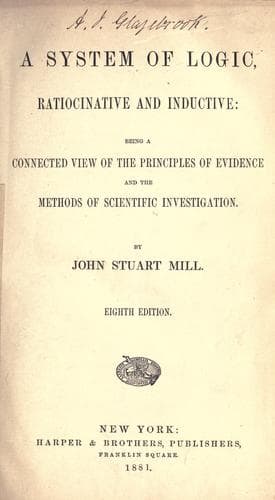
A System of Logic, Ratiocinative and InductiveMill, John Stuart
PhilosophyPhilosophy
A System of Logic, Ratiocinative and Inductive
Mill, John Stuart
Knowledge, Theory of; Logic; Science -- Methodology
§ 2. It is usual, before examining the various classes into which names
are commonly divided, to begin by distinguishing from names of every
description, those words which are not names, but only parts of names.
Among such are reckoned particles, as _of_, _to_, _truly_, _often_; the
inflected cases of nouns substantive, as _me_, _him_, _John’s_; and even
adjectives, as _large_, _heavy_. These words do not express things of
which any thing can be affirmed or denied. We can not say, Heavy fell, or
A heavy fell; Truly, or A truly, was asserted; Of, or An of, was in the
room. Unless, indeed, we are speaking of the mere words themselves, as
when we say, Truly is an English word, or, Heavy is an adjective. In that
case they are complete names—viz., names of those particular sounds, or of
those particular collections of written characters. This employment of a
word to denote the mere letters and syllables of which it is composed, was
termed by the schoolmen the _suppositio materialis_ of the word. In any
other sense we can not introduce one of these words into the subject of a
proposition, unless in combination with other words; as, A heavy _body_
fell, A truly _important fact_ was asserted, A _member_ of _parliament_
was in the room.
An adjective, however, is capable of standing by itself as the predicate
of a proposition; as when we say, Snow is white; and occasionally even as
the subject, for we may say, White is an agreeable color. The adjective is
often said to be so used by a grammatical ellipsis: Snow is white, instead
of Snow is a white object; White is an agreeable color, instead of, A
white color, or, The color white, is agreeable. The Greeks and Romans were
allowed, by the rules of their language, to employ this ellipsis
universally in the subject as well as in the predicate of a proposition.
In English this can not, generally speaking, be done. We may say, The
earth is round; but we can not say, Round is easily moved; we must say, A
round object. This distinction, however, is rather grammatical than
logical. Since there is no difference of meaning between _round_, and _a
round object_, it is only custom which prescribes that on any given
occasion one shall be used, and not the other. We shall, therefore,
without scruple, speak of adjectives as names, whether in their own right,
or as representative of the more circuitous forms of expression above
exemplified. The other classes of subsidiary words have no title whatever
to be considered as names. An adverb, or an accusative case, can not under
any circumstances (except when their mere letters and syllables are spoken
of) figure as one of the terms of a proposition.
Public-domain text, read in full here on John Shaqi.
Reviews
Reviews
No reviews yet
Be the first to share your thoughts on this work.
Join the Discussion
Join the discussion
Sign in to leave a comment or review.
Sign InorCreate an account