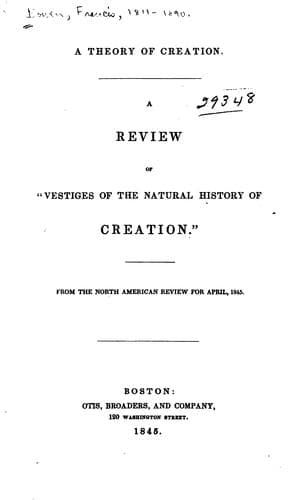
A Theory of Creation: A Review of 'Vestiges of the Natural History of Creation'Bowen, Francis
Religion
A Theory of Creation: A Review of 'Vestiges of the Natural History of Creation'
Bowen, Francis
Chambers, Robert, 1802-1871. Vestiges of the natural history of creation; Creation; Evolution (Biology)
no means as an established fact in astronomical science. And, as a
hypothesis, it labors under this peculiar difficulty, that it evidently
never can be verified. It must ever remain a _mere_ guess, directly
opposed by an obvious induction from those nebulae which are resolvable
into perfect stars.
The fact, that one or two bright points, assumed to be centres of
aggregation, are seen in some of these nebulae, is of no importance. If a
bright star be seen from this earth in the same line of vision with the
nebula, it will be projected on the ground of that nebula, and will
appear as a part of it, though it may be many millions of miles on this
side, and have no more connection with it than the planet Jupiter would
have, if it should happen to be in conjunction with the nebula, and thus
appear for a short time to be projected upon its disc.
There is one consideration of some weight, though we have never seen it
adverted to, which tends directly to confute the nebular hypothesis.
That faint radiance called the zodiacal light, which is seen to stream
up in the form of a cone from our sun, is assumed by our author to be a
residuum of the nebulous matter belonging to our system, which has not
yet been drawn into the sun, though it is on its way thither. Others
have supposed, with far more probability, that it is the sun's
atmosphere, and therefore its present shape and size will never
change,--as they never have changed, during the period in which they
have been observed by man. But no matter; we are now reasoning upon our
author's hypothesis. If the zodiacal light be composed of primitive
nebulous matter, it must now be comparatively thick and dense, since the
process of aggregation has been going on for countless ages, and, in our
system, is considered as nearly completed; just as when a sediment is
forming in a tumbler full of turbid water, after the upper portion of
the fluid has become entirely clear, there will be a stratum of water
next to the sediment more turbid than the whole was before the
deposition began. Yet this light is very faint, when seen only from the
distance of our earth; and at the boundaries of our system, from the
orbit of Uranus, for instance, we cannot believe that it is visible at
all. Is it likely, then, that a portion of this nebulous matter, in
which the process of deposition has hardly begun, and which is seen from
a distance so vast, that in comparison with it the whole diameter of our
solar system is but a point, would be visible from this earth? In the
case of the other nebulae, a multitude of perfectly formed suns, uniting
their respective beams, are seen only as a faint, whitish speck on the
blue arch. And yet we are required to believe, that the luminous matter
which will ultimately form but one sun, or perhaps two, while still
thinly diffused over an immense tract of space, the process of
aggregation having hardly commenced, is yet visible to our eyes at this
vast distance.
Public-domain text, read in full here on John Shaqi.
Reviews
Reviews
No reviews yet
Be the first to share your thoughts on this work.
Join the Discussion
Join the discussion
Sign in to leave a comment or review.
Sign InorCreate an account