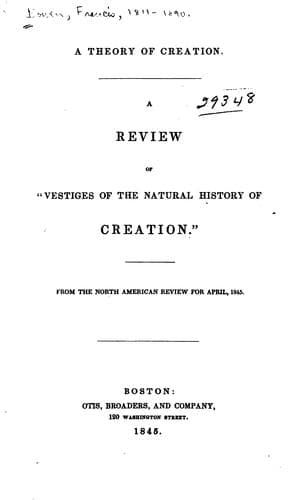
A Theory of Creation: A Review of 'Vestiges of the Natural History of Creation'Bowen, Francis
Religion
A Theory of Creation: A Review of 'Vestiges of the Natural History of Creation'
Bowen, Francis
Chambers, Robert, 1802-1871. Vestiges of the natural history of creation; Creation; Evolution (Biology)
It may be asked, if divine power, instead of operating immediately
throughout the universe, might not have endowed material atoms at the
outset with certain properties and energies, the gradual evolution of
which in after ages would produce all the phenomena of nature, without
the necessity of his incessant presence, agency, and control. Certainly,
we may not put bounds to omnipotence; though we may assert of a given
hypothesis respecting its exercise, that it is inconceivable, or
involves wholly incongruous ideas. The necessary attributes of matter,
according to our conception of it, are extension, figure,
impenetrability, and inertness; the properties of mind are thought,
sensation, activity, and will. These attributes are essential, not
arbitrary or contingent; for they make up our whole idea of the
substances in which they inhere. We can no more suppose them to be
interchangeable, than we can literally attribute dimensions to an odor,
or capacity to a sound. To speak of an extended thought, an impenetrable
sensation, an inert activity, is to talk nonsense; it is equally absurd
to attribute thought to extension, sensation to figure, activity to
inertness,[3] or causal agency to matter. True, mind may be superadded
to matter, without being confounded with it, and without any exchange of
properties. And in fact, this is the only conceivable form of the
hypothesis now before us; namely, the theory of the ancient
metaphysicians, that every particle of matter and every aggregate of it
is accompanied, or animated, by a distinct mind. "_Ea quoque [sidera]
rectissime et animantia esse, et sentire atque intelligere, dicantur._"
If this be a more intelligible and plausible supposition than that of
one infinite mind, pervading the universe, and producing all physical
changes by its irresistible power, the materialist is welcome to the
benefit of it.
Public-domain text, read in full here on John Shaqi.
Reviews
Reviews
No reviews yet
Be the first to share your thoughts on this work.
Join the Discussion
Join the discussion
Sign in to leave a comment or review.
Sign InorCreate an account