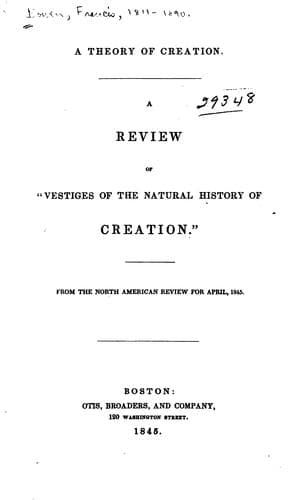
A Theory of Creation: A Review of 'Vestiges of the Natural History of Creation'Bowen, Francis
Religion
A Theory of Creation: A Review of 'Vestiges of the Natural History of Creation'
Bowen, Francis
Chambers, Robert, 1802-1871. Vestiges of the natural history of creation; Creation; Evolution (Biology)
As respects the manner in which all physical effects are produced by the
direct action of the Deity, we are not bound to offer any explanation,
as the subject confessedly transcends the limit of the human faculties.
It is enough for us, that the supposition is the only conceivable one,
the only mode of accounting for the phenomena of the material world. But
as man is made in the image of his Creator, in the union for a time of
his spirit with his corporeal frame we may find at least an intelligible
illustration of the connection of God with the universe. Discarding the
word _mind_, as the fruitful source of vague speculation and error, let
us look for a moment at that of which it is a mere synonyme,--at the man
himself. The sentient, thinking being, which I call _self_, is an
absolute unit. Duality or complexity cannot be predicated of it in any
intelligible sense. Personality is indivisible; _I_ am _one_. This being
is capable of acting in different ways; and for convenience of speech
and classification, these modes of action have been arranged as the
results of different faculties; though, in truth, it is no more proper
to attribute to the person distinct powers and organs for comparison,
memory, and judgment, than to give to the body separately a walking
faculty, a lifting faculty, a jumping faculty, and so on. In the one
case, these faculties are but different aspects of mental power; in the
other, but different applications of muscular strength. Of course, the
complex material frame, with its numberless adaptations and
arrangements, in which this being is lodged, is truly foreign from the
man himself, having a kind of connection with him, in reality, but one
degree more intimate than that of his clothes. The body is the curiously
contrived machine through which the man communicates with the material
world. The eye is but his instrument to see with, the ear is his trumpet
for communicating sound to him, the leg is his steed, and the arm his
soldier. Many of these instruments and parts may be removed, or become
unfit for use, without impairing, in the slightest degree, his distinct
personality and intelligence. The particles of all of them are in a
state of constant flux and renovation, so that man changes his body only
a little more frequently than he does his coat. His whole corporeal
frame is connected with him but for a while, and is then thrown aside,
like an old garment, for which he has no farther use.
Public-domain text, read in full here on John Shaqi.
Reviews
Reviews
No reviews yet
Be the first to share your thoughts on this work.
Join the Discussion
Join the discussion
Sign in to leave a comment or review.
Sign InorCreate an account