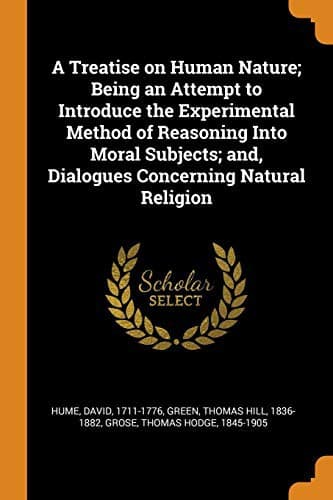
A Treatise of Human Nature: Being an Attempt to Introduce the Experimental Method Into Moral Subjects; and Dialogues Concerning Natural Religion — John Shaqi
A Treatise of Human Nature: Being an Attempt to Introduce the Experimental Method Into Moral Subjects; and Dialogues Concerning Natural ReligionHume, David
PhilosophyPhilosophy
A Treatise of Human Nature: Being an Attempt to Introduce the Experimental Method Into Moral Subjects; and Dialogues Concerning Natural Religion
Hume, David
Emotions; Ethics; Knowledge, Theory of; Philosophy, English
13. By insisting on Locke’s account of the relation between the
ideas of sensation and those of reflection we might be brought to a
different but not more luminous conclusion. In the passages quoted
above, where this relation is most fully spoken of, it appears that
the latter are essentially sequent to those of sensation. ‘_In
time_ the mind comes to reflect on its own operations, about the
ideas got by sensation, and thereby stores itself with a new set
of ideas, which I call ideas of reflection.’ Of these only two are
primary and original (Book II. c. xxi. sec. 73), viz. motivity or
power of moving, with which we are not at present concerned, and
perceptivity or power of perception. But according to Locke, as we
have seen, there cannot be any, the simplest, idea of sensation
without perception. If, then, the _idea_ of perception is only
given later and upon reflection, we must suppose perception to take
place without any idea of it. But with Locke to have an idea and
to perceive are equivalent terms. We must thus conclude that the
beginning of knowledge is an unperceived perception, which is against
his express statement elsewhere (Book II. c. xxvii. sec. 9), that it
is ‘impossible for any one to perceive without perceiving that he
does perceive.’
What is the ‘tablet’ impressed?
14. Meanwhile a perpetual equivocation is kept up between a supposed
impression on the ‘outward parts,’ and a supposed impression on the
‘tablet of the mind.’ It is not the impression upon, or a motion
in, the outward parts, as Locke admits, that constitutes the idea
of sensation. It is not an agitation in the tympanum of the ear,
or a picture on the retina of the eye, that we are conscious of
when we see a sight or hear a sound. [1] The motion or impression,
however, has only, as he seems to suppose, to be ‘continued to the
brain,’ and it becomes an idea of sensation. Notwithstanding the
rough line of distinction between soul and body, which he draws
elsewhere, his theory was practically governed by the supposition
of a cerebral something, in which, as in a third equivocal tablet,
the imaginary mental and bodily tablets are blended. If, however,
the idea of sensation, as an object of the understanding when a man
thinks, differs absolutely from ‘a motion of the outward parts,’
it does so no less absolutely, however language and metaphor may
disguise the difference, from such motion as ‘continued to the
brain.’ An instructed man, doubtless, may come to think about a
motion in his brain, as about a motion of the earth round the sun,
but to speak of such motion as an idea of sensation or an immediate
object of intelligent sense, is to confuse between the object of
consciousness and a possible physical theory of the conditions of
that consciousness. It is only, however, by such an equivocation that
any idea, according to Locke’s account of the idea, can be described
as an ‘impression’ at all, or that the representation of the mind as
Public-domain text, read in full here on John Shaqi.
Reviews
Reviews
No reviews yet
Be the first to share your thoughts on this work.
Join the Discussion
Join the discussion
Sign in to leave a comment or review.
Sign InorCreate an account