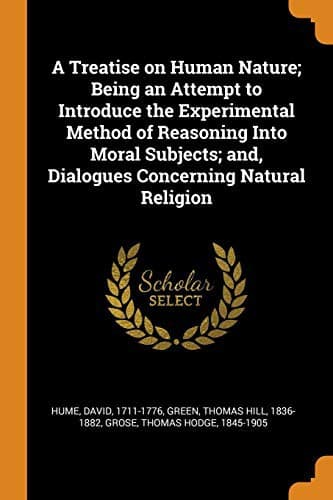
A Treatise of Human Nature: Being an Attempt to Introduce the Experimental Method Into Moral Subjects; and Dialogues Concerning Natural ReligionHume, David
PhilosophyPhilosophy
A Treatise of Human Nature: Being an Attempt to Introduce the Experimental Method Into Moral Subjects; and Dialogues Concerning Natural Religion
Hume, David
Emotions; Ethics; Knowledge, Theory of; Philosophy, English
a tablet, whether born blank or with characters stamped on it, has
even an apparent meaning. A metaphor, interpreted as a fact, becomes
the basis of his philosophical system.
[1] Cf. Locke’s own statement (Book III. c. iv. sec. 10). ‘The cause
of any sensation, and the sensation itself, in all the simple ideas
of one sense, are two ideas; and two ideas so different and distant
one from another, that no two can be more so.’
Does the mind make impressions on itself?
15. As applied to the ideas of reflection, indeed, the metaphor loses
even its plausibility. In its application to the ideas of sensation
it gains popular acceptance from the ready confusion of thought
and matter in the imaginary cerebral tablet, and the supposition
of actual impact upon this by ‘outward things.’ But in the case of
ideas of reflection, it is the mind that at once gives and takes
the impression. It must be supposed, that is, to make impressions
on itself. There is the further difficulty that as perception is
necessary in order to give an _idea_ of sensation, the impress of
perception must be taken by the mind in its earliest receptivity; or,
in other words, it must impress itself while still a blank, still
void of any ‘furniture’ wherewith to make the impression. There is no
escape from this result unless we suppose perception to precede the
idea of it by some interval of time, which lands us, as we have seen,
in the counter difficulty of supposing an unperceived perception.
Locke disguises the difficulty from himself and his reader by
constantly shifting both the receptive subject and the impressive
matter. We find the ‘tablet’ perpetually receding. First it is the
‘outward part’ or bodily organ. Then it is the brain, to which the
impression received by the outward part must somehow be continued,
in order to produce sensation. Then it is the perceptive mind, which
takes an impression of the sensation or has an idea of it. Finally,
it is the reflective mind, upon which in turn the perceptive mind
makes impressions. But the hasty reader, when he is told that the
mind is passively impressed with ideas of reflection, is apt to
forget that the matter which thus impresses it is, according to
Locke’s showing, simply its perceptive, _i.e._ its passive, self.
Source of these difficulties. The ‘simple’ idea, as Locke describes
it, is a complex idea of substance and relation.
Public-domain text, read in full here on John Shaqi.
Reviews
Reviews
No reviews yet
Be the first to share your thoughts on this work.
Join the Discussion
Join the discussion
Sign in to leave a comment or review.
Sign InorCreate an account