A Treatise on Bread, and Bread-making — John Shaqi
A Treatise on Bread, and Bread-makingGraham, Sylvester
History
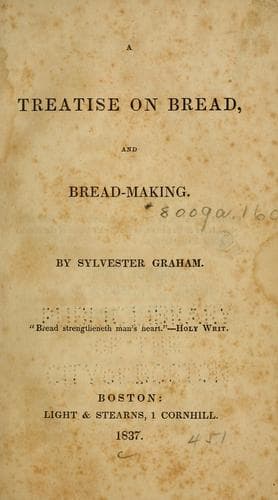
A Treatise on Bread, and Bread-making
Graham, Sylvester
Bread
“The use of alum in bread-making,” says a distinguished chemist,
“appears to be very ancient. It is one of those articles which have been
the most extensively and successfully used in disguising bad flour, and
the various adulterations of bread. Its injurious action upon the health
is not to be compared with that of sulphate of copper, and yet, daily
taken into the stomach, it may seriously affect the system.”
“Thirteen bakers were condemned on the 27th of January, 1829, by the
correctional tribunal of Brussels, for mixing sulphate of copper or blue
vitriol with their bread. It makes the bread very white, light, large
and porous, but rather tasteless; and it also enables the bread to
retain a greater quantity of water, and thereby very considerably
increases its weight. A much larger quantity of alum is necessary to
produce these effects; but when of sufficient quantity, it strengthens
the paste, and, as the bakers say, ‘makes the bread swell large.’”
If the statements of our large druggists can be relied on, the public
bakers of our own country probably employ ammonia more freely, at
present, than any other substance I have named. Pearlash or saleratus is
also used by them in considerable quantities.
But even where these adulterations are not practised, the bakers’ bread
is very rarely a wholesome article of diet.
If any dependence is to be placed on the testimony of several of the
principal bakers and flour merchants in New York, Boston and other
cities, the flour which most of our public bakers work into bread, is of
a very inferior quality to what is called good “family flour,” and for
which they pay from one to three dollars less per barrel; and they
sometimes purchase large quantities of old spoiled flour from New
Orleans and elsewhere, which has heated and soured in the barrel, and
perhaps become almost as solid as a mass of chalk; so that they are
obliged to break it up, and grind it over, and spread it out, and expose
it to the air, in order to purify it in a measure from its acid and
other bad properties; and then they mix it with a portion of much better
flour; and from this mixture they can make, as they say, the very
largest and finest looking loaf.[B]
But should the public bakers always use the best of flour, their bread,
as a general statement, would still be very inferior to well made
domestic bread, in point of sweetness and wholesomeness. Their mode of
manufacturing bread—to say the least of it—destroys much of the virtue
of the flour or meal; and hence their bread is only palatable—even to
those who are accustomed to it—within twelve, or at the longest,
twenty-four hours after it is baked.
Public-domain text, read in full here on John Shaqi.
Reviews
Reviews
No reviews yet
Be the first to share your thoughts on this work.
Join the Discussion
Join the discussion
Sign in to leave a comment or review.
Sign InorCreate an account