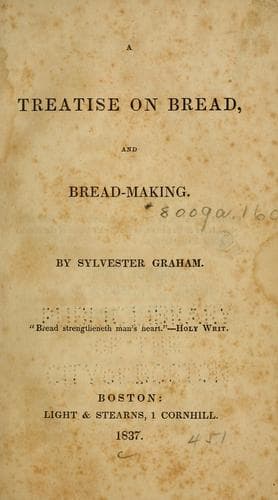
A Treatise on Bread, and Bread-makingGraham, Sylvester
History
A Treatise on Bread, and Bread-making
Graham, Sylvester
Bread
But I must repeat, that in making these statements, I am not prompted by
any unkind feelings towards public bakers; I have no doubt that they are
as honest in their calling as any other class of men; but perhaps there
is no other class pursuing an interest founded on the necessities of
their fellow creatures, whose expedients to increase the lucrativeness
of their business, are so immediately and universally injurious to the
health of those on whom they depend for support.
If any of my statements are thought to be exaggerated or incorrect, I
can only say, that with honest and benevolent intentions, I have
diligently sought for the truth; and if I have been in any respect
betrayed into error, I have been misinformed by public bakers
themselves, who certainly ought to know the truth in this matter; and
who could have no conceivable reason for making the general character of
their calling appear worse than it really is. Nevertheless, I have no
question that there are individuals in every city employed as public
bakers, who are too honest—too conscientious—too upright in heart, to be
guilty of any practice which they consider fraudulent or improper.
Still, truth compels me to declare, that if we would have good and
wholesome bread, it must be made within the precincts of our own
domestic threshold; and by those whose skill and care are exercised more
with a view to secure our health and happiness, than their own pecuniary
interest.
PROPERTIES OF BREAD.
Superfine flour injurious—a probable cause of some common disorders.
Objections to coarse bread. Its medical properties. Extensive
experiments of its use, by soldiers and others. Use among European
peasantry. Selection, preservation and grinding of wheat.
Whether our bread is of domestic manufacture or made by the public
baker, that which is made of superfine flour is always far less
wholesome, in any and every situation of life, than that which is made
of wheaten meal which contains all the natural properties of the grain.
It is true, that when much flesh is eaten with our bread, or when bread
constitutes but a very small and unimportant portion of our food, the
injurious effects of superfine flour bread are not always so immediately
and distinctly perceived as in other cases. Nevertheless, it is a
general and invariable law of our nature, that all concentrated forms of
food are unfriendly to the physiological or vital interests of our
bodies.
A very large proportion of all the diseases and ailments in civic life,
are originated by causes which are introduced into the alimentary canal
as articles of diet; and disturbance and derangement of
function—obstructions, debility and irritations, are among the most
important elements of those diseases.
Public-domain text, read in full here on John Shaqi.
Reviews
Reviews
No reviews yet
Be the first to share your thoughts on this work.
Join the Discussion
Join the discussion
Sign in to leave a comment or review.
Sign InorCreate an account