A Treatise on Bread, and Bread-making — John Shaqi
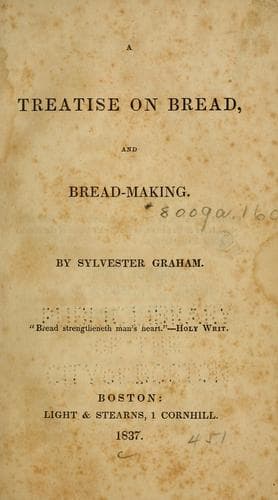
A Treatise on Bread, and Bread-makingGraham, Sylvester
History
A Treatise on Bread, and Bread-making
Graham, Sylvester
Bread
It is, probably, speaking within bounds, to say that nine tenths of the
adults, and nearly as large a proportion of youth in civic life, are
more or less afflicted with obstructions and disturbances in the stomach
and bowels, and other organs of the abdomen, the symptoms of which are
either habitual costiveness or diarrhœa, or an alternation of both; or
frequent and severe attacks of what are called bilious colics, &c., &c.;
and in children and youth, worms, fits, convulsions, &c. And I cannot
but feel confident, that the use of superfine flour bread is among the
important causes of these and numerous other difficulties.
I have indeed been surprised to observe, that in the hundreds of cases
of chronic diseases of every form and name, which have come to my
knowledge within the last five or six years, costiveness of the bowels
has in almost every instance been among the first and most important
symptoms. And I have never known this difficulty, even after an
obstinate continuance of five, ten, twenty or thirty years, fail to
disappear in a short time, after the coarse wheaten bread of a proper
character has been substituted for that made of superfine flour.
Some physicians and other individuals, without properly examining the
subject, have raised several objections against the coarse wheaten
bread.
It is said, in the first place, that bran is wholly indigestible, and
therefore should never be taken into the human stomach.
This objection betrays so much ignorance of the final causes and
constitutional laws, clearly indicated by the anatomical structure and
physiological economy of the alimentary organs, that it scarcely
deserves the slightest notice. If the digestive organs of man were
designed to receive nothing but digestible and nutrient substances, they
would have been constructed and arranged very differently from what they
are. As we have already seen, everything which nature provides for our
sustenance, consists of certain proportions of nutritious and
innutritious matter; and a due proportion of innutritious matter in our
food is as essential to the health and functional integrity of our
alimentary organs, as a due proportion of nutritious matter is to the
sustenance of the body.
Another objection is, that although bran may serve, like other
mechanical irritants and excitants, for a while, to relieve
constipation, yet it soon wears out the excitability of the organs, and
leaves them more inactive than before.
Here again, a false statement is urged by inexcusable ignorance; for it
is not true that the bran acts in the manner supposed in this objection;
nor are the effects here asserted ever produced by it.
Public-domain text, read in full here on John Shaqi.
Reviews
Reviews
No reviews yet
Be the first to share your thoughts on this work.
Join the Discussion
Join the discussion
Sign in to leave a comment or review.
Sign InorCreate an account