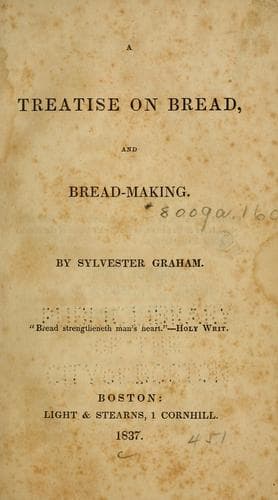
A Treatise on Bread, and Bread-making — John Shaqi
A Treatise on Bread, and Bread-makingGraham, Sylvester
History
A Treatise on Bread, and Bread-making
Graham, Sylvester
Bread
Here let it be understood, that the starch of the meal is of such a
nature that, by a delicate process peculiar to itself, it becomes
changed into sugar or saccharine matter; and when the fluid used in
mixing the dough is of a proper temperature, and the dough is properly
mixed and kneaded, this process, to some small extent, takes place, and
a small portion of the starch is actually converted into sugar, and
thereby increases the sweetness of the bread. Let it also be recollected
here, that the saccharine matter on which the yeast is to act, is
equally diffused throughout the whole mass of the meal; and therefore if
the yeast be not properly diffused throughout the whole mass, but is
unequally distributed, so that an undue quantity of it remains in one
part, while other parts receive little or none, then the fermentation
will go on very rapidly in some parts of the mass, and soon run into the
acetous state, while in other parts it will proceed very slowly or not
at all; and consequently large cavities will be formed in some parts of
the dough, while other parts of it will remain as compact and heavy as
when first mixed, and sometimes even more so. I need not say that such
dough cannot be made into good bread; yet it is probably true, that more
than nine tenths of the bread consumed in this country is more or less
of this character. Nor, after what I have said, should it seem necessary
for me to remark, that good bread cannot be made by merely stirring the
meal, and yeast, and water or milk together into a thin dough or sponge,
and suffering it to ferment with little or no working or kneading. Bread
made in this manner, if it is not full of cavities large enough for a
mouse to burrow in, surrounded by parts as solid as lead, is almost
invariably full of cells of the size of large peas and grapes; and the
substance of the bread has a shining, glutinous appearance; and if the
bread is not sour, it is because pearlash or some other kind of alkali
has been used to destroy the acid.
The very appearance of such bread is forbidding, and shows, at a glance,
that it has not been properly mixed—that the yeast has acted unequally
on different portions of the meal, and that the fermentation has not
been of the right kind.
Public-domain text, read in full here on John Shaqi.
Reviews
Reviews
No reviews yet
Be the first to share your thoughts on this work.
Join the Discussion
Join the discussion
Sign in to leave a comment or review.
Sign InorCreate an account