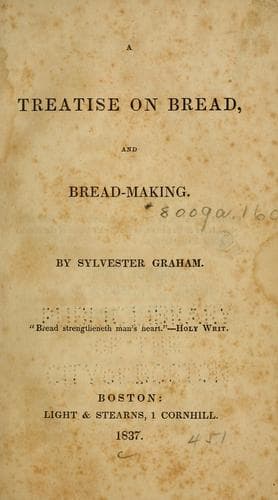
A Treatise on Bread, and Bread-makingGraham, Sylvester
History
A Treatise on Bread, and Bread-making
Graham, Sylvester
Bread
But if the yeast be so diffused throughout the whole mass, as that a
suitable portion of it will act on each and every particle of the
saccharine matter at the same time, and if the dough be of such a
consistency and temperature as not to admit of too rapid a fermentation,
then each minute portion of saccharine matter throughout the whole mass
will, in the process of fermentation, produce its little volume of air,
which will form its little cell, about the size of a pin’s head, and
smaller; and this will take place so nearly at the same time, in every
part of the dough, that the whole will be raised and made as light as a
sponge, before the acetous fermentation takes place in any part. And
then if it be properly moulded and baked, it will make the most
beautiful and delicious bread—perfectly light and sweet, without the use
of any alkali, and with all the gluten and nearly all the starch of the
meal remaining unchanged by fermentation.
Proper materials, proper care, a due amount of labor, a suitable length
of time, and proper temperature, are all, therefore, necessary to the
making of good bread.
With your meal, and yeast, and water or milk brought together before
you, then, proceed in the light of the instruction you have now
received, to mix your dough; and remember that the more thoroughly you
knead it, the more equally you diffuse the yeast throughout the whole
mass, and bring it to act on every particle of the saccharine matter at
the same time, and the whiter, lighter, and more delicious you make your
bread.
Who that can look back thirty or forty years to those blessed days of
New England’s prosperity and happiness, when our good mothers used to
make the family bread, but can well remember how long and how patiently
those excellent matrons stood over their bread troughs, kneading and
moulding their dough? and who with such recollections cannot also well
remember the delicious bread that these mothers used invariably to set
before them? There was a natural sweetness and richness in it which made
it always desirable; and which we cannot now vividly recollect, without
feeling a strong desire to partake again of such bread as our mothers
made for us in the days of our childhood.
Let it be borne in mind, then, that without a very thorough kneading of
the dough, there can be no just ground of confidence that the bread will
be good. “It should be kneaded,” says one of much experience in this
matter, “till it becomes flaky.” Indeed I am confident that our loaf
bread would be greatly improved in all its qualities, if the dough were
for a considerable time subjected to the operations of the machine which
the bakers call the break, used in making crackers and sea-bread.
Public-domain text, read in full here on John Shaqi.
Reviews
Reviews
No reviews yet
Be the first to share your thoughts on this work.
Join the Discussion
Join the discussion
Sign in to leave a comment or review.
Sign InorCreate an account