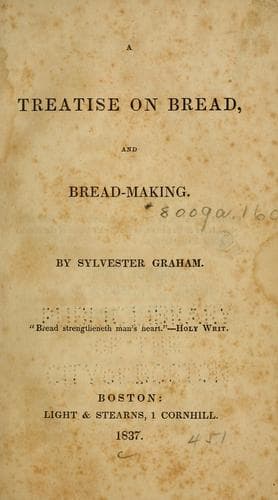
A Treatise on Bread, and Bread-makingGraham, Sylvester
History
A Treatise on Bread, and Bread-making
Graham, Sylvester
Bread
The wheat meal, and especially if it is ground coarsely, swells
considerably in the dough, and therefore the dough should not, at first,
be made quite so stiff, as that made of superfine flour; and when it is
raised, if it is found too soft to mould well, let a little more meal be
added.
When the dough has been properly mixed and thoroughly kneaded, cover it
over with a clean napkin or towel, and a light woollen blanket kept for
the purpose, and place the bread trough where the temperature will be
kept at about 60° F., or about summer heat, and there let it remain till
the dough becomes light. But as it is impossible to regulate the
quantity and quality of your yeast, the moisture and temperature of your
dough, and several other conditions and circumstances, so as to secure
at all times precisely the same results in the same time, it is
therefore necessary that careful attention should be given that the
proper moment should be seized to work over and mould the dough into the
loaf, and get it into the oven, just at the time when it is as light as
it can be made by the vinous fermentation, and before the acetous
fermentation commences.
If, however, by any means there should unfortunately be a little acidity
in the dough, take a small quantity of saleratus, or, what is better,
carbonate of soda, and dissolve it in some warm water, and carefully
work in just enough to neutralize the acid. The best bread-makers are so
exceedingly careful on this point, that they dip their fingers into the
solution of saleratus or soda, and thrust them into the dough in every
part, as they work it over, so as to be sure that they get in just
enough to neutralize the acid, and not a particle more.
I must here repeat, that they who would have the very best of bread,
must always consider it a cause of regret, that there should be any
necessity to use alkali; because the acetous fermentation cannot in any
degree take place, without commensurately and irremediably impairing the
quality of the bread. And here it should be remarked, that dough made of
wheat meal will take on the acetous fermentation, or become sour, sooner
than that made of fine flour. This is probably owing principally to the
mucilage contained in the bran, which runs into the acetous fermentation
sooner than starch.
Public-domain text, read in full here on John Shaqi.
Reviews
Reviews
No reviews yet
Be the first to share your thoughts on this work.
Join the Discussion
Join the discussion
Sign in to leave a comment or review.
Sign InorCreate an account