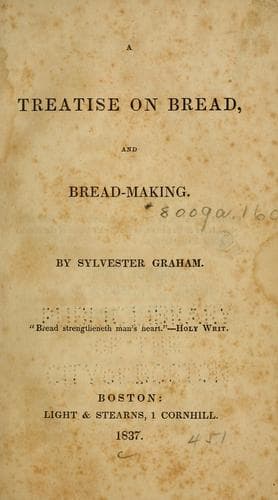
A Treatise on Bread, and Bread-makingGraham, Sylvester
History
A Treatise on Bread, and Bread-making
Graham, Sylvester
Bread
While the dough is rising, preparations should be made for baking it.
Some bake their bread in a brick oven, some in a stove, some in a
reflector, and some in a baking kettle. In all these ways very good
bread may be baked; but the baking kettle is decidedly the most
objectionable. Probably there is no better and more certain way of
baking bread well than in the use of the brick oven. Good bread-makers,
accustomed to brick ovens, can always manage them with a very great
degree of certainty; and as a general fact, bread is sweeter, baked in
this way, than in any other. Yet, when it is well baked in tin
reflectors, it is certainly very fine; and so it is also when well baked
in iron stoves. But the baking of bread requires almost as much care and
judgment as any part of the process of bread-making. If the oven is too
hot, the bread will burn on the outside before it is done in the centre;
if it is too cold, the bread will be heavy, raw and sour. If the heat is
much greater from below than from above, the bottom of the loaf will
burn before the top is done: or if the heat is much greater from above
than from below, the top of the loaf will burn before the bottom is
done.
All these points therefore must be carefully attended to; and no small
excuse ought to be considered a satisfactory apology for sour, heavy,
raw or burnt bread; for it is hardly possible to conceive of an absolute
necessity for such results; and the cases are extremely rare in which
they are not the offspring of downright and culpable carelessness.
The best bread-makers I have ever known, watch over their bread troughs
while their dough is rising, and over their ovens while it is baking,
with about as much care and attention as a mother watches over the
cradle of her sick child.
Dough made of wheat meal requires a hotter oven than that made of fine
flour; and it needs to remain in the oven longer. Indeed, it is a
general fault of bread of every description, made in this country, that
it is not sufficiently baked. Multitudes eat their bread hot and smoking
from the oven in a half-cooked state; and very few seem to think there
is any impropriety in doing so. But they who would have their bread
good, not only a few hours after it comes from the oven, but as long as
it can be kept, must see that it is thoroughly baked.
I have said that the process of vinous fermentation converts a portion
of the saccharine matter of the meal into carbonic acid gas or air, by
which means the dough is raised and made light; and that the same
process converts a portion of the saccharine matter into alcohol. The
alcohol thus generated is mostly if not entirely driven off by the heat
of the oven when the dough is baking;—and in modern times, ovens have
been so constructed in England, as to serve the double purpose of ovens
and stills; so that while the bread is baking, the alcohol is distilled
off and condensed, and saved for the various uses of arts and
manufacture.
Public-domain text, read in full here on John Shaqi.
Reviews
Reviews
No reviews yet
Be the first to share your thoughts on this work.
Join the Discussion
Join the discussion
Sign in to leave a comment or review.
Sign InorCreate an account