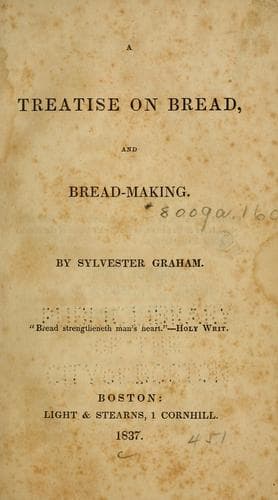
A Treatise on Bread, and Bread-makingGraham, Sylvester
History
A Treatise on Bread, and Bread-making
Graham, Sylvester
Bread
The question has, however, been frequently started, whether a portion of
the alcohol thus generated, is not contained in the bread when it comes
from the oven.
This question cannot be answered with entire certainty; but there are
some facts in relation to it of considerable importance.
It is perfectly certain that if two portions of wheat meal or flour be
taken from the same barrel or sack, and one portion be made into
unleavened bread, and the other portion be made into the very best
fermented or raised bread, and both be eaten as soon as they are baked,
the fermented bread will digest with more difficulty, and oppress and
disturb the stomach more than the unleavened bread will. Indeed it is
well known and very generally understood, that few of the articles which
compose the food of man in civic life, are so trying to the human
stomach, and so powerful causes of dyspepsia, as fresh-baked raised
bread.
It is now well known also that alcohol wholly resists the action of the
solvent fluid of the stomach, and is entirely indigestible; and always
retards the digestion of those substances which contain it. How far all
this may be true of carbonic acid gas, is not yet ascertained; but it is
difficult to account for the difference between leavened and unleavened
bread, as above stated, without supposing that the alcohol or carbonic
acid gas, or both of them, are in some degree concerned in rendering the
leavened bread, when newly baked, peculiarly oppressive and injurious to
the stomach.
This, be it remembered, is purely a conjecture of my own; and I am not
entirely certain that it is correct; but I see no other way of meeting
the difficulty.
Be it as it may, however, it is very certain that when the bread has
been drawn from the oven, and permitted to stand in a proper place
twenty-four hours, either by evaporation or some other means, it becomes
perfectly matured, and so changed in character, that it is, if properly
made, one of the most wholesome articles entering into the diet of man;
and at that age, there is not the slightest reason to believe that a
particle of alcohol remains in the bread.
When therefore the bread is thoroughly baked, let it be taken from the
oven and placed on a perfectly clean and sweet shelf, in a perfectly
clean and well ventilated pantry. Do not, as you value the character of
your bread, put it into a pantry where you set away dishes of cold meat,
cold potatoes, and other vegetables, and keep your butter, cheese and
various other table provisions—in a pantry which perhaps is seldom
thoroughly cleansed with hot water and soap, and where the pure air of
heaven seldom if ever has a free circulation. The quality of your bread
should be of too much importance to allow of such reprehensible
carelessness, not to say sluttishness. And if you will have your bread
such as every one ought to desire to have it, you must pay the strictest
attention to the cleanliness and sweetness of the place where you keep
it.
Public-domain text, read in full here on John Shaqi.
Reviews
Reviews
No reviews yet
Be the first to share your thoughts on this work.
Join the Discussion
Join the discussion
Sign in to leave a comment or review.
Sign InorCreate an account