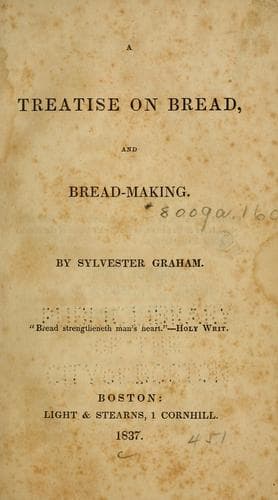
A Treatise on Bread, and Bread-makingGraham, Sylvester
History
A Treatise on Bread, and Bread-making
Graham, Sylvester
Bread
Let no one therefore say she cannot always have good bread, until she
can truly affirm that she has fairly made the experiment; that she has,
in view of all its relations and bearings, accurately estimated the
importance of the quality of her bread in regard to the welfare of her
household, and, with a proper sense of her responsibilities as a wife
and mother, has _at all times_ felt that interest and exercised that
care and attention which so important a duty demands, and without which
it must ever be a mere accident whether her bread is good or bad.
They that will have good bread, not only for a single time, but
uniformly, must make the quality of their bread of sufficient
importance, in their estimation and feelings, to secure the requisite
attention to the means by which alone such an end can be made certain.
They must not suffer themselves, through carelessness, to get entirely
out of bread unexpectedly, and thus be obliged, without due preparation,
to make up a batch of such materials as they may happen to have at hand,
and bake it in haste, and hurry it to the table. But they must exercise
providence and foresight: they must know, beforehand, when their supply
of bread will probably be out, and when they will need to make another
batch; and they must see beforehand that measures are taken to secure a
proper supply of all the requisite materials—see that they are furnished
with good meal or flour; and they must be sure to have the best of yeast
or leaven, when they need it—and when the time comes for them to make
their bread, if by any means the yeast should not be good, let them
throw it away and make good, before they proceed to make their bread;
for it is infinitely better that the family should even do without bread
one day, and eat roasted potatoes, than that they should eat poor bread
three or four days; and if, from any cause, the bread should be poor, it
is incomparably better to throw it away, than to set it upon the table,
to disgust the whole family with bread, and drive them to make most of
their meal on something else.
If a lady can ever find a good excuse for having poor bread, she
certainly can find none, except perhaps extreme poverty, for setting her
poor bread on the table the second time. Yet, too generally, women seem
to think that, as a matter of course, if they, by carelessness or any
other means, have been so unlucky as to make a batch of poor bread,
their family and friends must share their misfortune, and help them eat
it up; and, by this means, many a child has had its health seriously
impaired, and its constitution injured, and perhaps its moral character
ruined—by being driven, in early life, into pernicious dietetic habits.
Public-domain text, read in full here on John Shaqi.
Reviews
Reviews
No reviews yet
Be the first to share your thoughts on this work.
Join the Discussion
Join the discussion
Sign in to leave a comment or review.
Sign InorCreate an account