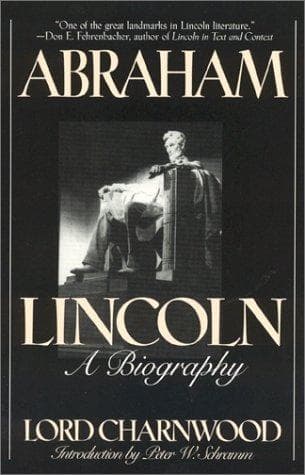
Abraham LincolnCharnwood, Godfrey Rathbone Benson, Baron
History
Abraham Lincoln
Charnwood, Godfrey Rathbone Benson, Baron
Lincoln, Abraham, 1809-1865; Presidents -- United States -- Biography
Whatever might be the case with an average Whig, a man like Lincoln would
be stirred in his heart by the general spirit of the country's
institutions, while the typical Democrat of that time would dwell
affectionately on the legal instruments and formal maxims in which that
spirit was embodied.
Of the Whigs it is a little harder to speak definitely, nor is it very
necessary, for in two only out of seven Presidential elections did they
elect their candidate, and in each case that candidate then died, and in
1854 they perished as a party utterly and for ever. Just for a time they
were identified with the "American policy" of Clay. When that passed out
of favour they never really attempted to formulate any platform, or to
take permanently any very definite stand. They nevertheless had the
adherence of the ablest men of the country, and, as an opposition party
to a party in power which furnished much ground for criticism, they
possessed an attraction for generous youth.
The Democrats at once, and the Whigs not long after them, created
elaborate party machines, on the need of which Jackson insisted as the
only means of really giving influence to the common people. The
prevailing system and habit of local self-government made such
organisation easy. Men of one party in a township or in a county
assembled, formulated their opinions, and sent delegates with
instructions, more or less precise, to party conventions for larger
areas, these would send delegates to the State Convention and these in
turn to the National Convention of the Party. The party candidates for
the Presidency, as well as for all other elective positions, were and are
thus chosen, and the party "platform" or declaration of policy was and is
thus formulated. Such machinery, which in England is likely always to
play a less important part, has acquired an evil name. At the best there
has always been a risk that a "platform" designed to detach voters from
the opposite party will be an insincere and eviscerated document, by
which active public opinion is rather muzzled than expressed. There has
been a risk too that the "available" candidate should be some blameless
nonentity, to whom no one objects, and whom therefore no one really
wants. But it must be observed that the rapidity with which such
organisation was taken up betokened the prevalence of a widespread and
keen interest in political affairs.
Public-domain text, read in full here on John Shaqi.
Reviews
Reviews
No reviews yet
Be the first to share your thoughts on this work.
Join the Discussion
Join the discussion
Sign in to leave a comment or review.
Sign InorCreate an account