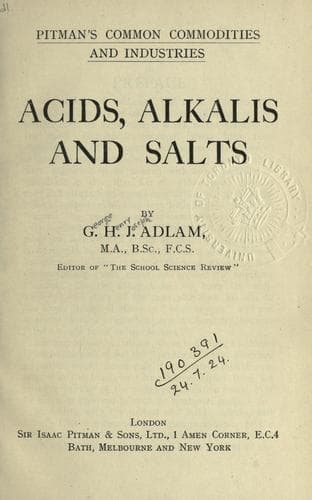
Acids, Alkalis and SaltsAdlam, George Henry Joseph
Science
Acids, Alkalis and Salts
Adlam, George Henry Joseph
Acids; Alkalies; Salts
The sulphur dioxide is produced as in the lead chamber process by
roasting iron pyrites in a current of air. This gas, together with the
excess of air, is passed into the contact furnace, which consists of
four tubes, each containing platinized asbestos, supported on perforated
plates. The union of the two gases is said to be almost complete: an
efficiency of 98 per cent. of the theoretical value is claimed for this
process. The sulphur trioxide, or “sulphuric anhydride”[1] is either
condensed in tin-lined drums or absorbed in ordinary concentrated
sulphuric acid.
The proposal to manufacture sulphuric acid by this method was first made
in 1831 by Peregrine Phillips, of Bristol. The early attempts were not
successful, and it was not until about forty-four years later that the
difficulties arising in the working of the contact process were overcome
sufficiently to enable the sulphuric acid produced in this way to be
sold at the same price as that made by the lead chamber process. Since
1890, the total quantity of acid made by the contact method has
increased very rapidly, so that it now furnishes about one-half of the
world’s supply, and seems likely in time to displace the lead chamber
process altogether.
The history of the rise of the contact process is interesting because it
illustrates in a striking manner the very great difference that there is
between a successful laboratory process and a successful manufacturing
process, though seemingly identical.
The first and possibly the most serious difficulty encountered in the
working of the contact process was the frequent interruption caused by
the loss of activity of the contact substance. Iron pyrites always
contains arsenic which volatilizes on heating, and this quickly caused
the platinum to lose its activity, or, as it was sometimes rather
fancifully expressed, “poisoned the catalyst.” Dust also is inevitable,
and this, carried forward mechanically with the stream of gas, settled
on the contact substance and caused the action to cease.
To get over this difficulty it is necessary to purify the gases. They
are first passed slowly through channels in which the coarser particles
of dust settle down. Steam is injected into the mixture to wash out the
finer particles of solid, and also to get rid of arsenic, and then the
gases are passed through scrubbers. Before being admitted to the contact
furnace, the moist gas is submitted to an optical test. It is passed
through a tube, the ends of which are transparent; a bright light is
placed at one end and viewed from the other through a column of gas of
considerable length. If the purification process is working
satisfactorily, there is a complete absence of fog. The gases are then
dried by passing through concentrated sulphuric acid and admitted to the
contact tubes.
Public-domain text, read in full here on John Shaqi.
Reviews
Reviews
No reviews yet
Be the first to share your thoughts on this work.
Join the Discussion
Join the discussion
Sign in to leave a comment or review.
Sign InorCreate an account