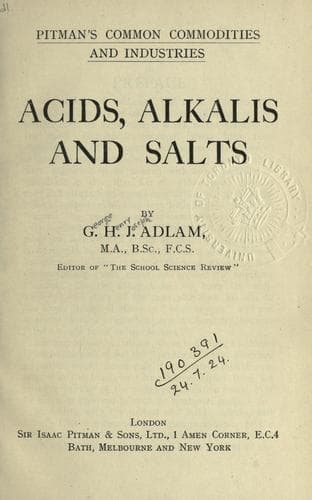
Acids, Alkalis and SaltsAdlam, George Henry Joseph
Science
Acids, Alkalis and Salts
Adlam, George Henry Joseph
Acids; Alkalies; Salts
In all operations carried out on a large scale, the regulation of
temperature is a matter of some difficulty. In the case which we are
considering, the most suitable temperature range is a rather narrow one,
and the difficulty of keeping within the limits is very much increased
by the large amount of heat given out when the sulphur dioxide and
oxygen combine. The result of the failure to maintain the temperature at
a fairly constant level was that the process worked in a very irregular
manner, for as soon as it was working really well and sulphur trioxide
was being formed rapidly, the heat given out by the reaction itself was
also great, and consequently, the higher temperature limit was exceeded.
The method of controlling the temperature in the contact process is
worth noting, because it is really ingenious. The tubes containing the
platinized asbestos are surrounded by wider concentric tubes. The gases
which are about to enter the contact furnace pass through the annular
space between the two tubes, and are thereby heated to the required
temperature, while at the same time they serve to cool the inner tubes.
The most satisfactory temperature is about 400° C. The tubes are first
warmed to 300° C. to start the reaction, and thereafter the heat evolved
by the reaction itself is sufficient to keep it going.
The absorption of the sulphur trioxide also caused some difficulty at
first. This substance reacts most violently with water, dissolving with
a hissing sound like that produced when a red-hot poker is plunged into
water. At the same time great heat is developed, and consequently, much
of the sulphur trioxide is vaporized, and in that way lost. This
difficulty was got over by using 98 per cent. sulphuric acid for the
absorption, the acid being kept at this strength by the simultaneous
addition of water.
The contact process has some very distinct advantages over the older
lead chamber process. The plant covers a much smaller area than the
bulky lead chambers. Although the preliminary purification of the gases
is somewhat tedious and costly, this is in great measure compensated by
the purity of the acid produced. No separate plant is required for
concentration and purification, as in the older process. Finally,
sulphuric acid of any concentration can be produced at will, including
the fuming acid, which is required as a solvent for indigo, and in the
manufacture of artificial indigo and other organic chemicals.
Public-domain text, read in full here on John Shaqi.
Reviews
Reviews
No reviews yet
Be the first to share your thoughts on this work.
Join the Discussion
Join the discussion
Sign in to leave a comment or review.
Sign InorCreate an account