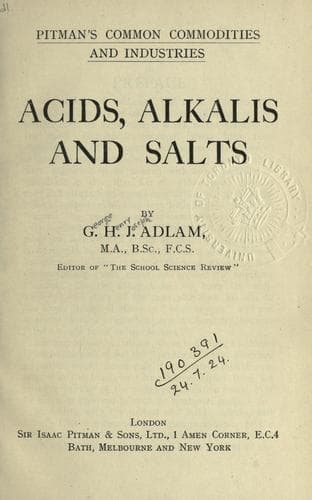
Acids, Alkalis and SaltsAdlam, George Henry Joseph
Science
Acids, Alkalis and Salts
Adlam, George Henry Joseph
Acids; Alkalies; Salts
The lead chamber process produces what is called chamber sulphuric acid
very cheaply. Although this is only a 60-70 per cent. solution and very
impure, nevertheless, it is quite good enough for the heavy chemical
trade, particularly for the first stage of the Leblanc soda process, and
for making superphosphate. These two industries alone consume many
thousands of tons of this sulphuric acid every year. Probably for some
years to come the two processes will continue to exist side by side, but
it may be doubted whether new works will now be installed to make
sulphuric acid by the lead chamber process.
Properties of Sulphuric Acid. The pure non-fuming acid is a colourless
oily liquid whose density is 1·84. It mixes with water in all
proportions, yielding dilute sulphuric acid, and it also dissolves
sulphur trioxide, yielding the fuming acid.
The mixing of sulphuric acid and water is accompanied by an evolution of
heat and by contraction in volume. It is an operation which must be
carried out with great care, the acid being always poured into the
water, otherwise the water floats on the heavier acid, and so much heat
is developed at the surface of separation that some of the water will be
suddenly converted into steam, and this, escaping from the liquid with
explosive violence, may cause the contents of the vessel to be scattered
about.
Strong sulphuric acid chars most organic substances. From substances
such as wood, sugar, paper, starch, it withdraws the elements of water,
liberating carbon. Since it acts in the same way upon human flesh, it is
clear that the concentrated acid must be handled with very great care,
for it causes most painful burns. For this reason, vitriol throwing has
always been regarded as a most serious and dastardly offence. A simple
first-aid remedy for burns produced by sulphuric acid is the liberal
application of an emulsion of linseed oil and lime water. The lime,
being an alkali, neutralizes the acid, and the oil excludes air from the
wound.
The readiness with which sulphuric acid combines with water is often
made use of both in the laboratory and in industrial Chemistry for the
purpose of drying gases. One illustration of this use has already been
given in describing the contact process. Another instance which may be
fairly familiar occurs in the case of liquefying air, where the gas must
be thoroughly dried before being passed into the refrigerating
apparatus, otherwise this would soon become blocked with ice.
Public-domain text, read in full here on John Shaqi.
Reviews
Reviews
No reviews yet
Be the first to share your thoughts on this work.
Join the Discussion
Join the discussion
Sign in to leave a comment or review.
Sign InorCreate an account