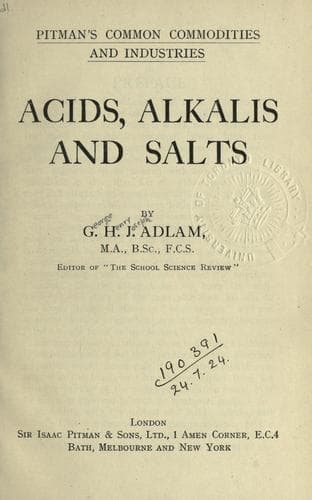
Acids, Alkalis and SaltsAdlam, George Henry Joseph
Science
Acids, Alkalis and Salts
Adlam, George Henry Joseph
Acids; Alkalies; Salts
The explanation of the method is as follows. The lime which is added
neutralizes the carbonic acid combined with the calcium bicarbonate, and
the result is the same as in the former case where this carbonic acid
was decomposed by heating, for calcium carbonate is thrown out of
solution.
For domestic purposes, water is softened by the addition of washing
soda. Since this reacts with all the calcium and magnesium compounds
forming the insoluble carbonates, all hardness, both temporary and
permanent, is removed.
CHAPTER VI
PHOSPHORIC, BORIC, AND SILICIC ACIDS
The acids which are grouped in this chapter are not in themselves of
much interest, though some of their salts are extremely important
compounds.
Bone. Much of the refuse bone, sooner or later, reaches the marine
store, and from that point starts on a career of usefulness in the
industrial world.
“Green bone,” as it is then called, may have fat adhering to it or
confined in its hollow interior as marrow. This is recovered by
treatment with benzine, and after that the bone is subjected to the
action of superheated steam in order to convert cartilage into glue. In
some cases, the residue is then ground up to make bone meal, which is
valuable as a manure because of the calcium phosphate which it contains.
In this way, the phosphate returns again to the animal kingdom, for it
supplies plants with the phosphates that they require, and from the
vegetable kingdom it passes to animals and helps to build up bone again.
Calcium Phosphate and Bone Black. Instead of being ground up, bone may
be heated in a retort in much the same way as coal is treated for the
manufacture of coal gas; bone oil is distilled off, and a non-volatile
residue, called bone black or animal charcoal, remains. This contains
about 90 per cent. of calcium phosphate and 10 per cent. of finely
divided carbon disseminated throughout the mass. It has the peculiar
property of absorbing colouring matter, and is used for this purpose in
the sugar industry and in the preparation of fine chemicals.
Phosphoric Acid. After being some time in use, bone black loses the
property of absorbing colouring matter; and though it can be “revived”
several times by heating it strongly in a closed retort, it ultimately
becomes spent and of no further use to the sugar refiner. It is then
heated again, this time in an open vessel, until all the carbon is burnt
away. The residue is now a greyish solid consisting mainly of calcium
phosphate. This, supplemented with native phosphate, which is probably
fossilized bone, is used for the preparation of phosphoric acid.
Public-domain text, read in full here on John Shaqi.
Reviews
Reviews
No reviews yet
Be the first to share your thoughts on this work.
Join the Discussion
Join the discussion
Sign in to leave a comment or review.
Sign InorCreate an account