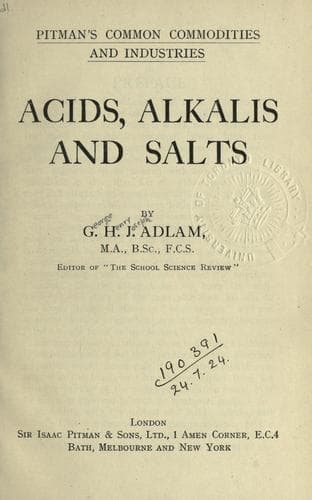
Acids, Alkalis and SaltsAdlam, George Henry Joseph
Science
Acids, Alkalis and Salts
Adlam, George Henry Joseph
Acids; Alkalies; Salts
The salt is decomposed by sulphuric acid in wooden vats; calcium
sulphate is formed, and ultimately settles on the bottom of the vat,
leaving a clear supernatant liquid, which is a dilute solution of
phosphoric acid. This liquid is drawn off and evaporated to a syrup.
This is “syrupy” phosphoric acid. On being still more strongly heated,
the syrup loses still more water, and a semi-transparent glassy-looking
substance, called metaphosphoric acid, remains.
Superphosphate. All fertile soils, especially those on which wheat is to
be grown, must contain a certain amount of phosphate. With this, as with
all other plant foods, the actual percentage weight required in the soil
is very small indeed, but it is necessary that it should be disseminated
throughout the soil. Even distribution is very difficult to secure in
the case of a substance like calcium phosphate, which is practically
insoluble in water.
To get over this difficulty, calcium phosphate is converted into a
mixture known as “superphosphate” by the following process. Bone ash or
the mineral phosphate is finely ground and thoroughly mixed by machinery
with two-thirds its weight of sulphuric acid from the lead chambers.
After a time, this mixture sets to a hard mass, containing principally
gypsum and calcium tetrahydrogen phosphate. It is then ground up finely
and is ready for use.
The special modification of calcium phosphate contained in
superphosphate is soluble in water. It is, therefore, carried into the
soil in solution, and in this way very evenly distributed. In the soil
it reacts with the lime or chalk which is present, and is gradually
reconverted into insoluble calcium phosphate.
The manufacture of superphosphate is a very important industry. The
weight of the substance produced annually in Great Britain alone is not
far below a million tons.
Basic Slag. In the Bessemer process for converting iron into steel, cast
iron is melted up in a vessel called a converter and, by the aid of a
powerful blast blown through the molten iron, most of the impurities are
burnt off. If, however, phosphorus and sulphur are present, they are not
removed if the converter has a silica (acid) lining. The original
Bessemer process was, therefore, modified by Thomas and Gilchrist, and
the converter for this kind of iron is lined with dolomite and lime
(basic lining). Phosphorus is then converted into phosphate and retained
by the lining, which is subsequently removed, ground up finely, and sold
as “basic slag.”
Boric Acid, or boracic acid, is familiar because it is used in medicine
as a mild antiseptic; it is also employed as a preservative for food. It
is a white crystalline compound, sparingly soluble in water. It has no
well-marked taste, and causes only a partial change in the colour of
litmus solution; it is, therefore, one of the weak acids. It does not
dissolve metals, but it displaces carbon dioxide from carbonates,
forming salts.
Public-domain text, read in full here on John Shaqi.
Reviews
Reviews
No reviews yet
Be the first to share your thoughts on this work.
Join the Discussion
Join the discussion
Sign in to leave a comment or review.
Sign InorCreate an account