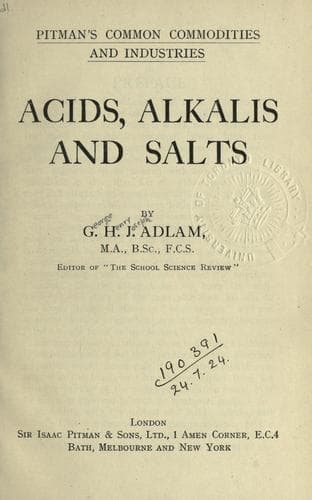
Acids, Alkalis and SaltsAdlam, George Henry Joseph
Science
Acids, Alkalis and Salts
Adlam, George Henry Joseph
Acids; Alkalies; Salts
Native borax or “tinkal” comes from Thibet and also from Ceylon. In
California, a large quantity of borax is obtained from a borax lake, and
also from the mud of marshes in its neighbourhood.
Silica. The element silicon does not occur in the free state in Nature,
neither has any particular use been found for it, and therefore it is
not often isolated except to provide a lecture specimen. The compounds
of silicon, however, are both plentiful and important, especially
silica, the oxide, and the silicates or salts of silicic acid.
The commonest forms of silica are sand, flint, and quartz. Silver sand
is composed of small crystals of pure silica, while flint is the
amorphous variety of the same substance. Quartz, or rock crystal, is a
very hard and transparent mineral. It forms six-sided prisms ending in
pyramids. It is distinguished from other common transparent minerals,
such as calcspar, by the fact that it cannot be scratched even with a
good knife or file, and that a drop of hydrochloric acid has no action
on it. The melting point of silica is very high.
Sometimes silica is very delicately coloured with minute traces of
metallic oxides and other substances, and these forms, because of their
rarity and beauty, are more highly valued. Smoky quartz, cat’s-eye, and
amethyst are some of the coloured varieties of quartz. Opal, agate,
jasper, onyx, and chalcedony are, in the chemist’s classification,
merely coloured flints.
In recent years, chemical apparatus has been made from pure fused
silica. This can only be worked in the oxy-hydrogen blow-pipe flame or
in the electric furnace; nevertheless, crucibles, flasks, beakers, and
retorts can be made. Silica ware has several advantages over glass,
notably, that water has no action upon it at all; moreover, its
coefficient of expansion is so very small that a piece of apparatus made
of silica can be suddenly heated or cooled without risk of fracture;
indeed, it can be made red-hot and cooled immediately by plunging into
cold water.
Quartz or silica fibres, used for suspending magnets and other bodies in
very delicate physical apparatus, are made in the following way. Molten
silica is attached to the bolt of a crossbow, which is then released
above a carpet of black velvet. As the bolt flies forward, it draws out
the silica into a filament, which is so fine that it would be difficult
to find were it not for the velvet background.
Silicic Acid itself is only of theoretical interest. It is obtained by
adding hydrochloric acid to a solution of potassium or sodium silicate.
It is a gelatinous substance of somewhat indefinite composition. It has
no effect on litmus, no taste, and no solvent action; in fact, it is
only recognizable as an acid because it dissolves in alkalis, forming
salts called silicates. It is one of the weakest acids known.
Public-domain text, read in full here on John Shaqi.
Reviews
Reviews
No reviews yet
Be the first to share your thoughts on this work.
Join the Discussion
Join the discussion
Sign in to leave a comment or review.
Sign InorCreate an account