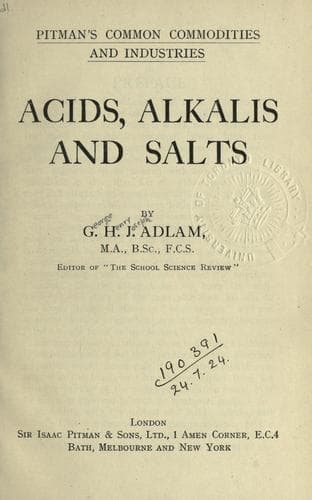
Acids, Alkalis and SaltsAdlam, George Henry Joseph
Science
Acids, Alkalis and Salts
Adlam, George Henry Joseph
Acids; Alkalies; Salts
The natural silicates are very abundant and varied; orthoclase or potash
felspar, and albite or soda felspar, are those which most commonly
occur. The former is potassium aluminium silicate, and the latter,
sodium aluminium silicate. Iron is generally present in both as an
impurity. The weathering of the felspars, in conjunction with the action
of water, has produced the clays. In this way, pure white China clay has
been formed from felspars which contain little or no iron, and the
coarser kinds of clay from others containing a greater proportion of
foreign substances.
Mica, which is used for making lamp chimneys, is a potassium aluminium
silicate. Asbestos, meerschaum, beryl, garnet, jade, and hornblende are
all silicates of various metals.
Glass is a complex mixture of insoluble silicates with excess of silica.
The varieties in common use are soda glass, Bohemian glass, and lead
glass (which is also called flint glass). Soda glass is mainly a mixture
of calcium and sodium silicates, and is distinguished by its low melting
point, which makes it easy to work at moderate temperatures. It appears
in commerce as plate glass, window glass, and common bottles. Bohemian
glass contains calcium and potassium silicates, and has a high melting
point. It is used for making chemical apparatus. Lead or flint glass
contains the silicates of lead and potassium; this is a dense glass, but
at the same time rather soft. It takes a high polish and is used for
making ornamental or cut-glass ware.
Remembering that glass is composed of the salts of silicic acid, the
reader will readily understand that the mixture from which it is made
must contain acidic and basic constituents. The acidic or acid-forming
material is in every case silica or sand. This must be pure, and for all
but the commonest kind of bottle or window glass, it must be free from
iron, otherwise the glass will have a more or less pronounced greenish
colour. It must also be fine and even grained. Formerly, the glass sands
used in this country came from Holland and Belgium, but now supplies
from several British sources are being successfully used.
The basic portion of the glass mixture differs according to the kind of
glass required. An average mixture for soda glass contains sand, 20
parts; salt cake (sodium sulphate), 10 parts; quicklime, 5 parts;
charcoal, 1 part. For Bohemian glass, pearl ash (potassium carbonate)
takes the place of salt cake, and no charcoal is necessary because the
materials used are finer. For lead glass, the mixture is still further
modified by the use of litharge, or more often red lead, in place of
lime.
Public-domain text, read in full here on John Shaqi.
Reviews
Reviews
No reviews yet
Be the first to share your thoughts on this work.
Join the Discussion
Join the discussion
Sign in to leave a comment or review.
Sign InorCreate an account