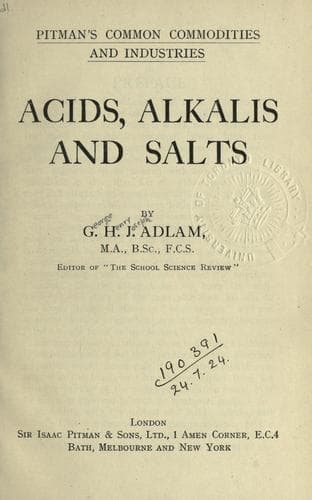
Acids, Alkalis and SaltsAdlam, George Henry Joseph
Science
Acids, Alkalis and Salts
Adlam, George Henry Joseph
Acids; Alkalies; Salts
The ingredients are well mixed and thoroughly dried. Waste glass from a
previous batch is also added. The mixture is heated to about 1200° C. in
large pots made of Stourbridge clay, and the heating is continued for as
much as sixteen hours, and until the whole of the material in the pot is
molten and fairly mobile. Scum or glass-gall is removed, and when gas
bubbles have disappeared, the temperature is allowed to fall to
700°-800°, when the glass becomes sufficiently viscous for subsequent
working. The semi-fluid mass is then blown, moulded, or drawn, according
to the kind of article that is required.
The physical properties of glass will now be considered in order that we
may be able to account for its extended use. Such an inquiry as this,
especially in the case of materials in common use, is often interesting,
because it frequently happens that the special property upon which we
set so much value is an abnormal one and, consequently, the feature
which we take for granted is precisely the one into which we should
inquire most closely.
The most striking feature of glass is its transparency. This property is
abnormal, if glass is a solid. Consider what happens in most cases. A
substance like nitre melts easily and in the molten state is perfectly
transparent; when it cools, crystals form and, though these individually
may be transparent, yet the solid mass is opaque. The reason for this is
that the solid is not optically homogeneous, and therefore a ray of
light cannot pass through it in a straight line. At each facet of a
crystal light is deviated and reflected, and in the end is almost wholly
scattered. Consequently, an object, even if it can be seen at all, can
be discerned only in a blurred and indistinct fashion through such a
medium.
There are very good reasons, however, for supposing that glass is not a
true solid but an extremely viscous liquid. If glass is heated, it
softens and begins to flow very sluggishly at first, but afterwards more
readily. There is no abrupt change, as there generally is in passing
from the solid to the liquid state. Similarly in cooling, there is no
point at which it is possible to say that the glass is solidifying. The
view that this substance is really a liquid is perhaps a little
startling at first, but it becomes less so when we observe that a long
glass rod supported at its ends in a horizontal position sags in the
middle and is permanently deformed.
To avoid that change which would be technically called solidification by
a scientist, the article which has been fashioned in glass is cooled
down very slowly and gradually. This part of the process is called
annealing; it may occupy some days in extreme cases, and it points to
the fact that experience has shown that it is necessary to guard against
some change which would normally take place if this precaution were
neglected.
Public-domain text, read in full here on John Shaqi.
Reviews
Reviews
No reviews yet
Be the first to share your thoughts on this work.
Join the Discussion
Join the discussion
Sign in to leave a comment or review.
Sign InorCreate an account