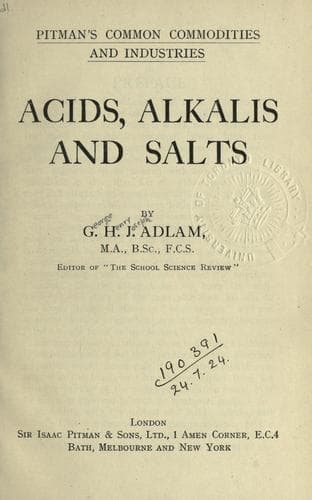
Acids, Alkalis and SaltsAdlam, George Henry Joseph
Science
Acids, Alkalis and Salts
Adlam, George Henry Joseph
Acids; Alkalies; Salts
The change in glass which annealing is intended to prevent is known as
devitrification. In spite of all precautions, this does occur sometimes,
and specimens of old window glass are often seen to have lost their
transparency completely and to have an opalescent sheen. In these cases,
the silicates have crystallized.
An extreme case of badly annealed glass is illustrated by Rupert’s
drops, a scientific curiosity of very old standing. These are “tears” of
glass made by dropping the molten substance into water. When the tail of
the drop is nipped off, the whole thing is shattered to powder with
something like explosive violence. Clearly there is a very great
internal strain, due to the fact that the outer parts have solidified
and contracted, while the inner part is still warm and dilated.
Another remarkable feature of glass is the ease and simplicity with
which it can be fashioned into articles of various shapes. As a plastic
material, molten glass almost ranks with clay. This again is due to the
property of passing through a viscous state, that is, one which is
intermediate between a solid and a liquid.
Water Glass, or soluble glass, is mainly sodium silicate. It is made by
fusing sand or powdered flint with caustic or with mild soda; sometimes,
by digesting crushed flint or chert with caustic soda solution under
considerable pressure in autoclaves or specially constructed boilers. In
the latter case, no extraction is necessary; but in the former, the
residue is treated with water and the solution evaporated until it
becomes a viscous transparent liquid.
This liquid is used in various ways in industry. It is added to the
cheaper varieties of yellow soap, and is employed as a mordant in dyeing
and printing calico. An artificial sandstone is made by mixing sand,
calcium chloride, and sodium silicate; the two last-named substances
interact to form calcium silicate, which is insoluble in water. For
domestic purposes, water glass is best known in connection with the
preserving of eggs. When the film of water glass dries on the surface of
the egg shell, the latter becomes impervious to air.
CHAPTER VII
ORGANIC ACIDS
Organic Chemistry. About a century ago, when the science of Chemistry
was still in its infancy, several substances were known which could then
only be obtained from animals or plants. The composition of these
substances was not understood, and they were not classified; moreover,
since none of them had ever been prepared artificially, it was supposed
that it was impossible to do this—the reason given was that “vital
force” was necessary for their production. In time, however, some of the
most typical animal and vegetable products were prepared in the
laboratory, and the belief in vital force disappeared.
Public-domain text, read in full here on John Shaqi.
Reviews
Reviews
No reviews yet
Be the first to share your thoughts on this work.
Join the Discussion
Join the discussion
Sign in to leave a comment or review.
Sign InorCreate an account