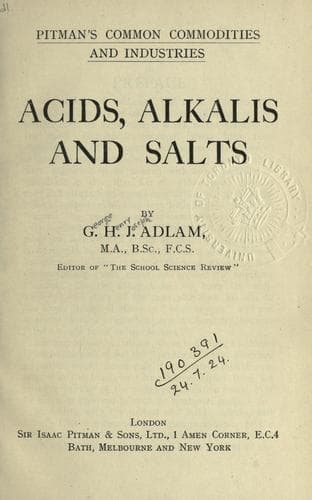
Acids, Alkalis and SaltsAdlam, George Henry Joseph
Science
Acids, Alkalis and Salts
Adlam, George Henry Joseph
Acids; Alkalies; Salts
Such a process seems to have been worked out in Germany. The
starting-point is acetylene gas made by the action of water on calcium
carbide. When this gas is passed through sulphuric acid containing
suspended mercuric oxide or dissolved mercury salt, the acetylene is
oxidized first to aldehyde and then to acetic acid.
If this process should prove to be successful, it will form the
starting-point of a new and important industry, for, apart from the
large amount of acetic acid which is used in commerce, there is the
production of the very important solvent known as acetone, which can be
made from acetic acid by a very simple operation.
Tartaric Acid. Grape juice contains a large quantity of potassium
hydrogen tartrate dissolved in it; when the liquid is fermented and
alcohol is formed, this salt crystallizes out because it is not soluble
in alcohol. After the new wine has been poured off, the salt is found as
a brownish crystalline residue adhering to the sides of the vat. Also
the salt goes on crystallizing after the wine is put into barrels, and
forms an incrustation on the sides. This is called the _lees_ or
sediment of wine. In commerce, the substance is known as _argol_
(sometimes spelt _argal_), and also _tartar_ of wine.
Crude argol is purified by dissolving it in water and destroying the
colour by boiling with animal charcoal. When the clear liquid obtained
from this mixture by filtration is evaporated, a white crystalline
substance separates out. This is potassium hydrogen tartrate or _cream
of tartar_.
Tartaric acid is obtained from cream of tartar. The salt is dissolved in
water and nearly neutralized with milk of lime. Insoluble calcium
tartrate is precipitated, and potassium tartrate remains in solution. A
further quantity of calcium tartrate is obtained by adding calcium
chloride to the solution just mentioned. The two precipitates of calcium
tartrate are then mixed and decomposed by dilute sulphuric acid, and
after the calcium sulphate is filtered off, tartaric acid is obtained as
a solid by evaporating the clear liquid.
The general properties of tartaric acid are well known. It is soluble in
water, giving a solution which has a pleasantly acid taste.
Citric Acid. The sharp flavour of many unripe fruits is due to the
presence of citric acid; the juice of lemons contains 5-6 per cent. of
the acid. The free acid is obtained in a manner precisely similar in
principle to that described for tartaric acid.
Public-domain text, read in full here on John Shaqi.
Reviews
Reviews
No reviews yet
Be the first to share your thoughts on this work.
Join the Discussion
Join the discussion
Sign in to leave a comment or review.
Sign InorCreate an account