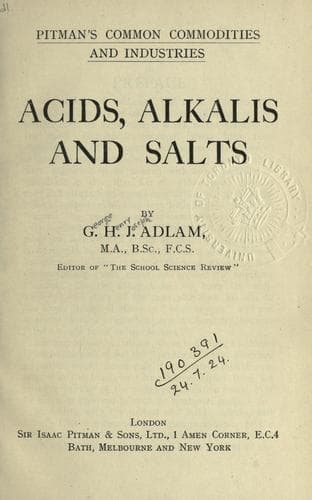
Acids, Alkalis and SaltsAdlam, George Henry Joseph
Science
Acids, Alkalis and Salts
Adlam, George Henry Joseph
Acids; Alkalies; Salts
Oxalic Acid. Oxalic acid and its salts, the oxalates, are very widely
distributed in the vegetable kingdom. These compounds are present in
wood sorrel (_Oxalis acetosella_), in rhubarb, in dock, and in many
other plants. The acid is made on a large scale by mixing pine sawdust
to a stiff paste with a solution containing caustic soda and potash. The
paste is spread out on iron plates and heated, care being taken not to
heat the mixture to the point at which it chars. The mass is then
allowed to cool, and is mixed with a small quantity of water to dissolve
out the excess of alkali. This is recovered and used again.
Sodium oxalate, which is the main product of the reaction described
above, is dissolved in water and treated with milk of lime, whereby
insoluble calcium oxalate is obtained, which is subsequently decomposed
with sulphuric acid, yielding oxalic acid.
Potassium hydrogen oxalate is sometimes called _salts of sorrel_, and
potassium quadroxalate, _salts of lemon_. The most familiar use of the
latter substance is in the removal of ink stains.
Oxalic acid and its salts are poisonous. The free acid has sometimes
been mistaken for sugar with fatal results.
Formic Acid (_L. formica_, an ant) is found both in the vegetable and in
the animal kingdom. If the leaf of a stinging nettle is examined with a
microscope, it is seen to be covered with long pointed hairs having a
gland at the base. This gland contains formic acid. When the nettle is
touched lightly, the fine point of the hair punctures the skin, and a
subcutaneous injection of formic acid is made, which quickly raises a
blister.
The inconvenience which arises from the stings of bees and wasps, also
from the fluid ejected by ants when irritated, is due to formic acid.
The remedy in each case is the same; the acid must be neutralized as
quickly as possible with mild alkali, such as washing soda.
Formic acid was first made by distilling an infusion of red ants. It is
now made from glycerine and oxalic acid.
The Fatty Acids. Animal fats and vegetable oils are similarly
constituted bodies. They are composed mainly of three chemical compounds
known as stearin, palmitin, and oleïn. Of these, stearin and palmitin
are solids at ordinary temperatures, while oleïn is a liquid. Hard fats
like those of mutton and beef are composed mainly of stearin; fats of
medium hardness contain stearin, palmitin, and some oleïn; while oils
such as cod-liver oil and olive oil are nearly pure oleïn.
Stearin, palmitin, and oleïn are analogous in composition to salts.
Their proximate constituents are glycerine and certain organic acids,
stearic, palmitic, and oleïc respectively.
In order to obtain the fat free from tissue which it contains in its
natural state, it is tied up in a muslin bag and heated in boiling
water. The fat is squeezed out through the meshes of the fabric and
floats on the surface of the water as an oil which solidifies on
cooling. This clarified fat is called tallow.
Public-domain text, read in full here on John Shaqi.
Reviews
Reviews
No reviews yet
Be the first to share your thoughts on this work.
Join the Discussion
Join the discussion
Sign in to leave a comment or review.
Sign InorCreate an account