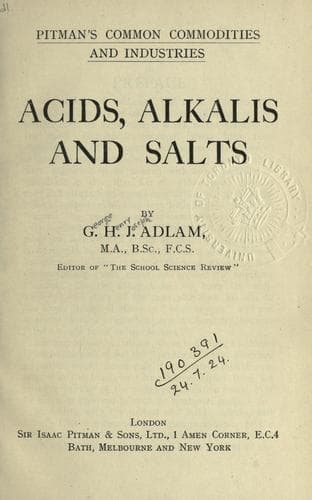
Acids, Alkalis and SaltsAdlam, George Henry Joseph
Science
Acids, Alkalis and Salts
Adlam, George Henry Joseph
Acids; Alkalies; Salts
The Leblanc process, too, has its advantages. In the next chapter we
shall see that it is adaptable for the production of caustic as well as
mild alkali. The chlorine which is recovered in the Leblanc process is a
very valuable by-product. In the Solvay process, chlorine is lost, for
hitherto no practicable method has been found for its recovery from
calcium chloride.
The position with regard to the future supply of alkali is very
interesting. The competition between the Leblanc and the Solvay
processes for supremacy in the market is very keen. At the same time,
both processes are in some degree of danger of being supplanted by the
newer electrical methods, which will be mentioned in the last chapter.
The following table shows very clearly the rapid progress made by the
Solvay process in ten years. The quantities are given in _tonnes_ (1
tonne = 0·9842 ton).
1884. 1894.
_Leblanc _Solvay _Leblanc _Solvay
soda._ soda._ soda._ soda._
Great Britain 380,000 52,000 340,000 181,000
Germany 56,500 44,000 40,000 210,000
France 70,000 57,000 20,000 150,000
United States — 1,100 20,000 80,000
Austria-Hungary 39,000 1,000 20,000 75,000
Russia — — 10,000 50,000
Belgium — 8,000 6,000 30,000
545,500 163,100 456,000 776,000
Mild Potash. Potassium carbonate (mild potash) was formerly obtained
from wood ashes. The clear aqueous extract was evaporated to dryness in
iron pots, and the substance was on this account called _potashes_;
later, potash. A whiter product was obtained by calcining the residue,
and this was distinguished as _pearl-ash_. Chemically pure potassium
carbonate was formerly obtained by igniting cream of tartar (potassium
hydrogen tartrate) with an equal weight of nitre. It is for this reason
that potassium carbonate is sometimes called “salt of tartar.”
About the middle of last century, natural deposits of potassium chloride
were discovered in Germany. The beds of rock salt near Stassfurt are
covered over with a layer of other salts, and for many years these were
removed and cast aside as “waste salts” (_abraumsalze_). When at a later
date they were examined more carefully, they were found to contain
valuable potassium compounds, notably the chloride. After that
discovery, mild potash was made by the Leblanc process., and Germany
controlled the world’s markets for all potassium compounds.
Public-domain text, read in full here on John Shaqi.
Reviews
Reviews
No reviews yet
Be the first to share your thoughts on this work.
Join the Discussion
Join the discussion
Sign in to leave a comment or review.
Sign InorCreate an account