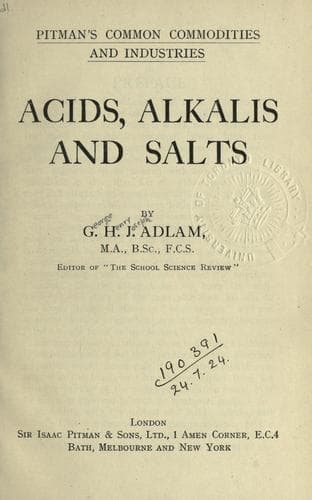
Acids, Alkalis and SaltsAdlam, George Henry Joseph
Science
Acids, Alkalis and Salts
Adlam, George Henry Joseph
Acids; Alkalies; Salts
At the outbreak of war, the German supplies of potassium compounds
ceased as far as the allied nations were concerned, and an older method
of making potassium chloride from _orthoclase_ or potash-felspar was
revived. This involves the heating of the powdered mineral to a high
temperature after mixing it with calcium chloride, lime, and a little
fluorspar. The potassium chloride is then extracted from the fused mass
with water. This method has been worked with great success in America,
and it is claimed that potassium chloride can be made in that country at
a cost which is lower than that formerly paid for the imported article.
Mild potash and soda are so very similar in chemical properties that in
most cases it is immaterial which compound is used. In all cases in
which there is this choice, soda is employed, both because it is cheaper
and because it is more economical, for 106 parts of soda ash are
equivalent to 138 parts of potash. There are, however, some occasions
when soda cannot be substituted, notably for the manufacture of hard
glass and soft soap, and for the preparation of caustic potash,
potassium dichromate, and other potassium salts.
Potassium Bicarbonate. This resembles the corresponding sodium salt in
nearly every respect. It is, however, much more readily soluble in
water, so much so, that it is not possible to obtain this substance by
the Solvay method. It is made from potassium carbonate by saturating a
strong aqueous solution of that substance with carbon dioxide.
CHAPTER IX
CAUSTIC ALKALIS
The Alkali Metals. The discovery of current electricity in 1790
furnished the chemist with a very powerful agency for bringing about the
decomposition of compounds. Hydrogen and oxygen were soon obtained by
passing an electric current through acidulated water; and in 1807, Sir
Humphry Davy, who is perhaps better remembered for his invention of the
miners’ lamp, isolated the metals sodium and potassium by subjecting
caustic soda and caustic potash respectively to the action of the
current.
Public-domain text, read in full here on John Shaqi.
Reviews
Reviews
No reviews yet
Be the first to share your thoughts on this work.
Join the Discussion
Join the discussion
Sign in to leave a comment or review.
Sign InorCreate an account