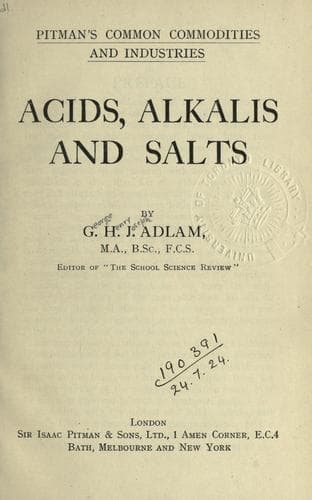
Acids, Alkalis and SaltsAdlam, George Henry Joseph
Science
Acids, Alkalis and Salts
Adlam, George Henry Joseph
Acids; Alkalies; Salts
Sodium and potassium are very remarkable metals. They are only a little
harder than putty, and can easily be cut with a knife or moulded between
the fingers. When exposed to the air, they rust or oxidize very rapidly,
so much so that they have to be preserved in some mineral oil or in
airtight tins. They are lighter than water, which they decompose with
the liberation of hydrogen, and under favourable circumstances the
hydrogen takes fire so that the metals appear to burn on the surface of
the water. After the reaction is over and the sodium or potassium has
disappeared, a clear colourless liquid remains which has a strongly
alkaline reaction, and when this is evaporated until the residue
solidifies on cooling, caustic soda or potash is obtained. For very
special purposes, the caustic alkalis are sometimes made by the action
of the metals on water, but for production on a large scale, less
expensive methods are adopted.
Caustic Alkali is obtained from the corresponding mild alkali in the
following way. The substance—washing soda, for example—is dissolved in
water and the solution is warmed. Lime is stirred into this solution,
and from time to time a small test portion of the _clear_ supernatant
liquid is removed and mixed with a dilute mineral acid. When this ceases
to cause effervescence, the change is complete. The clear liquid is now
separated from the solid matter (excess of lime together with calcium
carbonate) and evaporated in a metal dish. Since the caustic alkalis are
extremely soluble in water, they do not crystallize as do most of the
compounds previously described. Evaporation is, therefore, carried on
until the liquid which remains solidifies when cold.
Caustic Soda. To describe the process by which caustic soda is
manufactured, we must return to the making of black ash. The mixture
from which black ash is made contains limestone. It is heated to 1000°
C., which is a sufficiently high temperature to convert limestone into
lime. When the black ash is subsequently treated with water, the lime
which is present converts some of the mild alkali to caustic;
consequently, black ash liquor always contains both alkalis.
When the manufacturer intends to make caustic soda and not soda
crystals, the composition of the black ash mixture is varied by adding a
larger proportion of limestone, so that there may be an excess of lime
in the black ash produced. The treatment with water is carried out as
described under washing soda, and then more lime is added to convert the
mild soda into caustic soda. After the excess of lime and other
suspended matter has settled down, the clear caustic liquor is
evaporated in iron kettles until it becomes molten caustic, which will
solidify on being allowed to cool.
Public-domain text, read in full here on John Shaqi.
Reviews
Reviews
No reviews yet
Be the first to share your thoughts on this work.
Join the Discussion
Join the discussion
Sign in to leave a comment or review.
Sign InorCreate an account