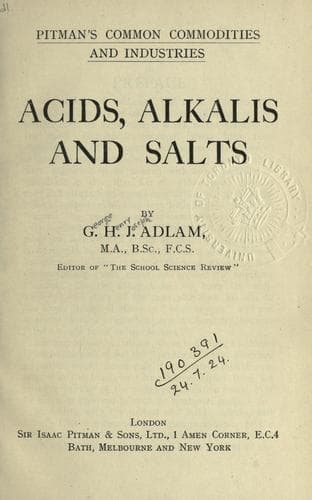
Acids, Alkalis and SaltsAdlam, George Henry Joseph
Science
Acids, Alkalis and Salts
Adlam, George Henry Joseph
Acids; Alkalies; Salts
There are various grades of caustic soda on the market differing one
from another in purity. The soap manufacturer uses caustic liquor or lye
containing about 40 per cent. of caustic soda. For other purposes, the
solid containing from 60 to 78 per cent. is used. Sometimes the product
is whitened by blowing air through the strong caustic liquor or by the
addition of a little potassium nitrate. Finally, for analytical
purposes, caustic soda is purified by dissolving it in alcohol and
subsequently evaporating the clear liquid.
Caustic Potash. The methods for the preparation of the corresponding
potassium compound are precisely the same as those described for caustic
soda; in fact, wherever the words sodium and soda occur in this chapter,
the reader can always substitute potassium and potash respectively.
Caustic Lime. Apart from its use in making mortar and cement, lime is
very often employed to neutralize acids. For this purpose, a suspension
in water, called milk of lime, is generally used, for lime itself is not
very soluble. Probably it is only the soluble part which reacts;
nevertheless, as soon as this is used up, more of the solid dissolves,
and in this way the action goes on as if all the lime were in solution.
Lime is also a very valuable substance in agriculture, especially on
damp, boggy land, where there is much decaying vegetable matter, and on
land which has been liberally manured. The soil in these cases is very
likely to become acid and is then unproductive. Lime is added to
“sweeten” the soil; in other words, to neutralize the acid.
Ammonia. The pungent smelling liquid popularly known as “spirits of
hartshorn” is a solution of ammonia gas in water. It is a caustic alkali
and, as such, is sometimes used to remove grease spots. Here, however,
we shall consider ammonia only in connection with ammonium salts, some
of which are used in very large quantity as fertilizers.
The principal source of ammonia at the present time is the ammoniacal
liquor obtained as a by-product in the manufacture of gas for heating
and lighting. Coal contains about 1 per cent. of nitrogen, and when it
is distilled, some of this nitrogen is given off as ammonia, which
dissolves in the water produced at the same time. This liquid is
condensed in the hydraulic main and in other parts of the plant where
the gas is cooled down.
Gas liquor contains chiefly the carbonate, sulphide, sulpho-cyanide, and
chloride of ammonia, together with many other substances, some of which
are of a tarry nature. It would not be practicable to evaporate this
liquid with a view to obtaining the ammonium salts, because it is only a
very dilute solution. Hence, after the removal of tar, the liquor is
treated in such a way that ammonia is set free.
Public-domain text, read in full here on John Shaqi.
Reviews
Reviews
No reviews yet
Be the first to share your thoughts on this work.
Join the Discussion
Join the discussion
Sign in to leave a comment or review.
Sign InorCreate an account