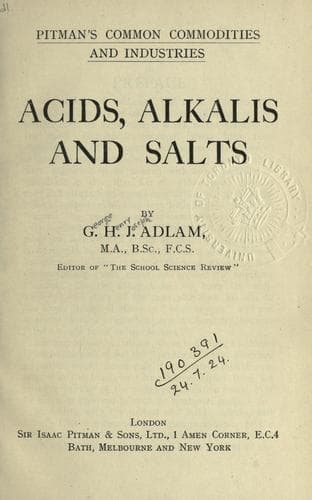
Acids, Alkalis and SaltsAdlam, George Henry Joseph
Science
Acids, Alkalis and Salts
Adlam, George Henry Joseph
Acids; Alkalies; Salts
In some cases the liberation of ammonia is accomplished by blowing
superheated steam into the liquor, which sets free the ammonia which is
combined as carbonate, sulphide, and sulpho-cyanide, but not that which
is present as chloride. In other works, the gas liquor is mixed with
milk of lime, which liberates all the combined ammonia. The ammonia is
then expelled from the mixture by a current of steam or air and steam.
In both cases, the gas which is given off is passed into sulphuric acid,
whereby ammonium sulphate is formed in solution and afterwards obtained
as a solid by evaporation.
Ammonium Salts
Ammonium Chloride. Like all other alkalis, ammonia solution neutralizes
acids, forming salts. With hydrochloric acid, it produces the white
solid known as _sal ammoniac_ or ammonium chloride. This compound is
familiar as the one required to make the liquid used in a Leclanché
cell, which is generally used as the current generator for electric
bells.
Ammonium Carbonate, which is also called stone ammonia and salt of
hartshorn, is made by subliming a mixture containing two parts chalk and
one part ammonium sulphate. It is a white solid which gives off ammonia
slowly and is, therefore, used as the basis for smelling salts.
Ammonium Nitrate is obtained by passing ammonia gas into nitric acid
until it is neutralized. It is a white solid, which melts easily on
being heated, and breaks up into water and nitrous oxide (laughing gas),
which is the “gas” administered by dentists. Ammonium nitrate is also
used in the composition of some explosives: for example, “ammonite” is
said to contain 80 per cent. of this substance.
Ammonium Sulphate is used chiefly as an artificial manure; the amount
required for this purpose throughout the world is over 1,500,000 tons
every year.
Synthetic Ammonia. Though the soluble compounds of nitrogen are fairly
abundant, the supply is by no means equal to the demand, because such
enormous quantities are required for agricultural purposes. It has been
already said that ammonia is obtained as a by-product in the
distillation of coal, and it has been repeatedly pointed out that our
coal supplies are far from inexhaustible; moreover, coal gas may not
always be used for lighting and heating. It, therefore, becomes a very
important question as to how the future supply of ammonium salts is to
be maintained.
Ammonia is a very simple compound formed from the elements nitrogen and
hydrogen, and, as before mentioned, the supply of free nitrogen in the
air is literally inexhaustible. In recent years, the efforts of chemists
have been directed towards finding a method of converting the free
nitrogen of the air into some simple soluble compound. This problem is
usually spoken of as the “fixation of nitrogen.”
Public-domain text, read in full here on John Shaqi.
Reviews
Reviews
No reviews yet
Be the first to share your thoughts on this work.
Join the Discussion
Join the discussion
Sign in to leave a comment or review.
Sign InorCreate an account