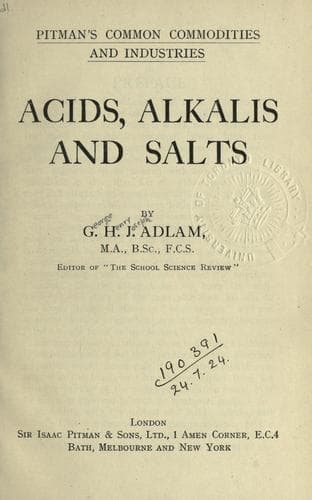
Acids, Alkalis and SaltsAdlam, George Henry Joseph
Science
Acids, Alkalis and Salts
Adlam, George Henry Joseph
Acids; Alkalies; Salts
Solution of Metals in Acids. Alkalis are not the only substances which
neutralize acids. Speaking in a broad and general sense, we may say that
an acid is neutralized when a metal is dissolved in it, because, when
the point is reached at which no more metal will dissolve, all the
characteristic properties of the acid are destroyed. A salt is formed in
this case also.
An example will now be given to illustrate this method of salt
formation. Before two pieces of metal can be united by soldering, it is
necessary to clean the surfaces of the metal and the soldering iron. The
liquid used for this purpose is made by adding scraps of zinc to
muriatic acid (hydrochloric acid). The zinc dissolves with
effervescence, which is caused by the escape of hydrogen gas. When
effervescence ceases and no more zinc will dissolve, the liquid is ready
for use. The acid has been “killed” or neutralized by the metal. A salt
called zinc chloride has been formed. This salt can be recovered from
the liquid by evaporation.
Solution of Oxides in Acids. The substances most used in commerce with
the express purpose of destroying acidity are quicklime, washing soda,
and powdered chalk.
Since quicklime is a compound of the metal calcium and the gas oxygen,
its systematic name is calcium oxide; when it neutralizes an acid, it
forms the corresponding calcium salt; for example, if it neutralizes
acetic acid, calcium acetate is formed.
An instance of the neutralization of an acid by an oxide of a metal is
furnished by one method of preparing blue vitriol (copper sulphate).
Copper does not dissolve very quickly in dilute sulphuric acid; hence,
to make blue vitriol from scrap copper, the metal is first heated very
strongly while freely exposed to air. Copper and oxygen of the air
combine to form the brownish black powder, copper oxide, and this
dissolves very readily in sulphuric acid, making the salt, copper
sulphate.
Solution of Carbonates in Acids. Washing soda and chalk belong to a
different class of chemical substances. They are carbonates, that is,
they are salts of carbonic acid. At first it may seem a little
perplexing to the reader to learn that a salt can neutralize an acid to
form a salt. It must be remembered, however, that acids differ from one
another in strength, that is, in chemical activity, and that carbonic
acid is a weak acid. When a salt of carbonic acid—sodium carbonate or
washing soda, for example—is added to a stronger acid such as sulphuric
acid, sodium sulphate is formed and carbon dioxide liberated.
Public-domain text, read in full here on John Shaqi.
Reviews
Reviews
No reviews yet
Be the first to share your thoughts on this work.
Join the Discussion
Join the discussion
Sign in to leave a comment or review.
Sign InorCreate an account